

Understanding Relationship Counseling Cost Before You Start
Relationship counseling cost depends most on the session format, therapist training, location, session length, and whether insurance or workplace benefits apply. The best first step is to ask for the full fee, expected session length, and a realistic treatment plan before booking.
It also helps to budget for a course of care, not just one appointment. Some couples need focused help with one issue. Others need more time to rebuild trust, manage ongoing conflict, or decide what they want next.
Insurance may cover counseling when treatment is connected to one partner’s diagnosed mental health condition, but relationship concerns alone are often not covered. If cost is a concern, ask about telehealth, sliding scale openings, Employee Assistance Programs, and supervised university clinics.
This guide compares your options so you can find support that fits both your relationship needs and your budget.
Average Relationship Counseling Cost by Setting and Format
When planning for mental health care, looking at single appointments can sometimes feel confusing. A complete course of couples therapy involves regular weekly or biweekly work to establish new patterns, meaning the overall financial plan matters far more than an isolated visit.
Private practice rates vary widely based on several practical considerations. Major metropolitan regions usually have higher rates due to clinic overhead expenses and high cost of living, while suburban or rural practices often offer lower rates. The physical setting also plays a significant role, as maintaining a private office requires commercial leases, administrative support, and operational expenses that shape private pay fee structures.
| Counseling Setting | Typical Session Length | Scheduling Pacing | Primary Advantages |
|---|---|---|---|
| In Person Private Practice | 50 to 90 minutes | Weekly or Biweekly | Neutral shared space, deep nonverbal observation |
| Telehealth Video Sessions | 50 to 80 minutes | Flexible scheduling | No commute, access to clinicians across the state |
| University Training Clinics | 50 to 60 minutes | Weekly | Supervised graduate care, budget conscious rates |
| Intensive Weekend Programs | Multi hour blocks | 1 to 3 days | Rapid momentum, concentrated skill building |
In Person Private Practice vs. Telehealth Sessions
Choosing between in person appointments and couples therapy online comes down to comfort, scheduling logistics, and budget. Telehealth options frequently reduce indirect expenses like transportation, parking, and childcare. Virtual care allows partners to connect with skilled clinicians anywhere in their home state, expanding access beyond high cost neighborhood practices.
While both formats produce strong clinical outcomes, virtual sessions offer exceptional convenience for busy couples managing demanding work schedules or parenting duties. In person therapy provides a dedicated physical environment outside the home, which some partners find helpful for emotional focus when tackling delicate conversations.
Session Length and Frequency Considerations
Standard individual therapy appointments generally run for 50 minutes. Because a couples therapist manages two distinct perspectives at the same time, many clinicians recommend 75 or 90 minute sessions.
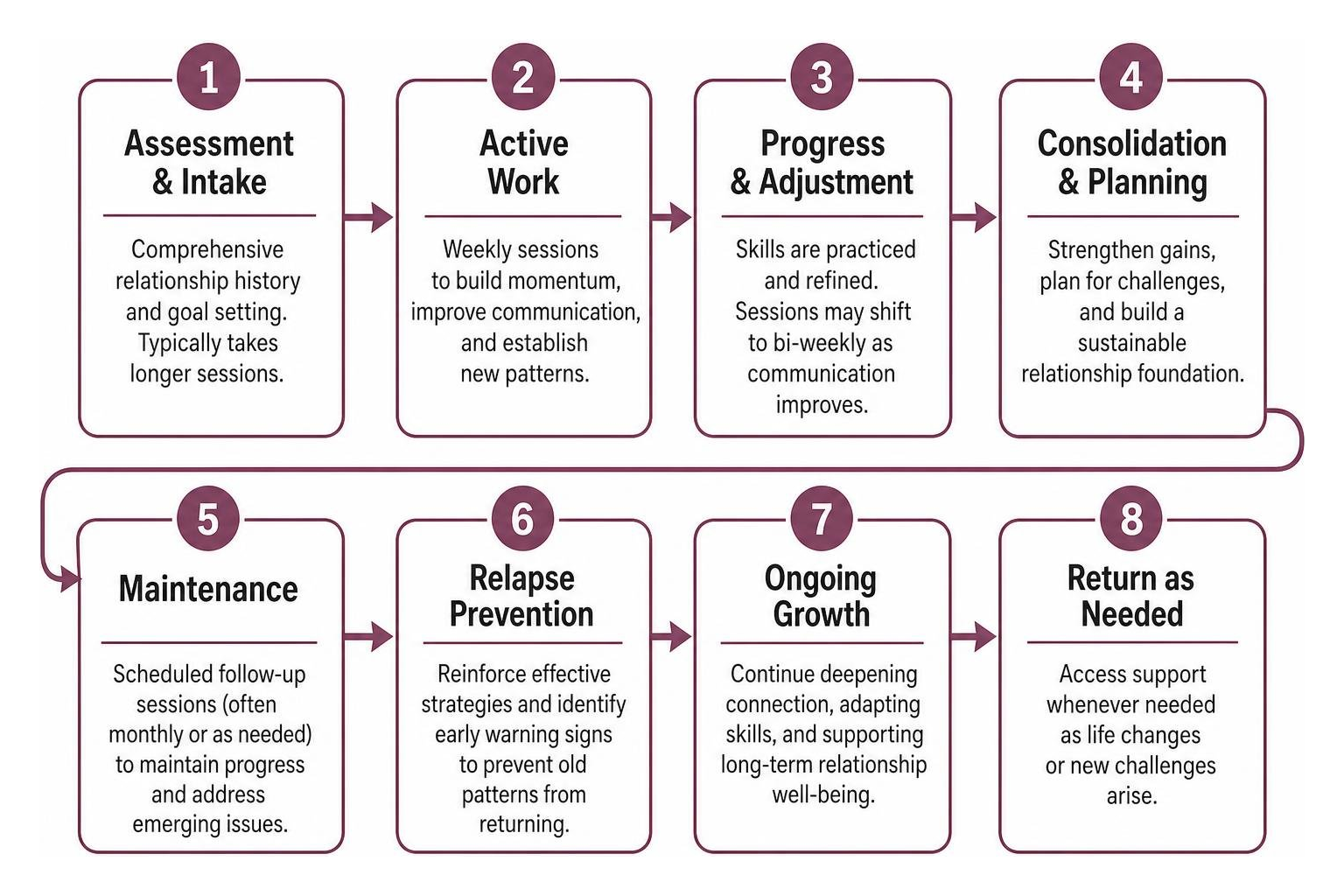
An intake assessment typically takes longer so the clinician can take a thorough relationship history. After the initial assessment phase, most couples attend weekly sessions to build momentum before spacing visits to every other week as their communication improves. Factoring in longer appointment times helps ensure your ongoing financial plan matches your clinical goals.
What Drives the Price: Modalities, Credentials, and Treatment Length
The credentials and advanced education of your provider significantly influence session rates. Licensed Marriage and Family Therapists receive systemic education tailored directly to relational systems. Licensed Clinical Social Workers, Licensed Professional Counselors, and clinical psychologists bring specialized diagnostic and relational toolsets. Providers with doctoral degrees or decades of clinical experience may charge higher standard fees.

Estimating Relationship Counseling Cost by Therapy Modality
Clinicians who pursue advanced, multitiered certifications in evidence based couples modalities invest substantial time and resources into their training. These modalities offer clear structures that can lead to efficient progress:
- Emotionally Focused Therapy (EFT): Rooted in adult attachment theory, EFT helps couples identify negative interaction cycles and build secure emotional bonds. EFT research summaries report that roughly 70 to 75 percent of couples move from distress to recovery with this approach.
- The Gottman Method: Built on decades of relationship research, this modality utilizes structured questionnaires and exercises to improve conflict management, fondness, and shared meaning. It is ideal for couples seeking couples therapy for communication.
- Imago Relationship Therapy: Focuses on understanding childhood attachment patterns and transforming unconscious conflict into conscious connection.
- Discernment Counseling: A specialized, short term protocol designed for couples where one partner is leaning out of the relationship and the other wants to stay. This approach usually concludes in one to five sessions, helping both individuals gain total clarity on whether to pursue comprehensive therapy or separate amicably.
Total Treatment Duration and Issue Severity
The nature of the distress directly influences how many sessions will be necessary. Addressing mild communication tune-ups or completing premarital counseling often requires a brief course of care. In contrast, complex dynamics involving longstanding resentment require greater patience.
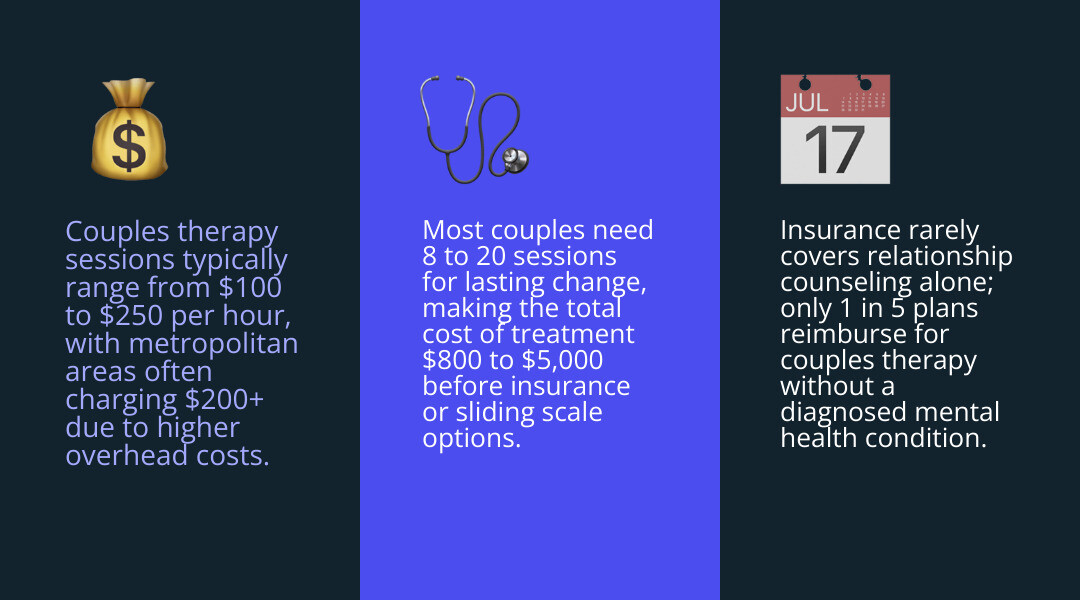
When partners seek out couples therapy for conflict, an average course often spans 8 to 20 sessions. For acute ruptures, such as navigating couples therapy for infidelity, rebuilding trust and healing trauma generally requires 20 to 30 sessions or more. Seeking support early, before negative cycles become deeply entrenched, remains the most effective way to keep overall treatment duration manageable.
Insurance Coverage, Diagnostic Billing, and Payment Alternatives
Navigating insurance for relationship therapy can be complex. Traditional health plans operate around the principle of medical necessity, which requires a diagnosed mental health condition defined in clinical diagnostic manuals. Because relationship distress or marital conflict is classified as a relational situation rather than an individual illness, standard plans generally do not cover pure couples enrichment.

Managing Relationship Counseling Cost Through Insurance and Benefits
When understanding couples therapy insurance dynamics, it helps to understand billing mechanics. Insurance policies often cover conjoint sessions under specific billing codes when one partner is diagnosed with a recognized condition, such as generalized anxiety or depression, and relationship counseling is medically necessary to support that partner’s treatment.
Before starting care, it is wise to learn more about how does insurance cover therapy under your specific plan. If your provider is out of network, they can supply an itemized receipt or superbill that you may submit to your plan for possible partial reimbursement, depending on your out of network deductible and benefits.
Low Cost Community Resources and Benefit Programs
For couples seeking quality support on a tighter budget, several options exist:
- Employee Assistance Programs (EAPs): Many workplace benefit packages include a set number of free, confidential counseling sessions per year that can address relationship strain and workplace stress.
- University Training Clinics: Graduate universities with accredited psychology or marriage and family therapy programs offer community clinics where advanced student interns provide care under the direct supervision of fully licensed faculty.
- Sliding Scale Fee Openings: Many private practitioners reserve sliding scale slots with adjusted rates based on verified household income.
- Flexible Spending and Health Savings Accounts: HSA or FSA funds may be available when therapy qualifies as medical care, such as treatment for a diagnosed mental health condition. The IRS states that marital counseling itself is not a qualified medical expense. Exploring practical tips for finding affordable therapy can open doors to accessible care without sacrificing professional quality.
Comparing Counseling Costs to Solo Therapy and the Cost of Inaction
When weighing mental healthcare options, looking at the return on investment can help bring clarity. While relationship coaching and educational workshops exist for basic skill development, they are not regulated healthcare services. Licensed therapy provides the clinical depth needed to address underlying trauma, attachment wounds, and persistent behavioral patterns.
Individual Therapy vs. Couples Counseling
Couples therapy requires a clinician to hold space for two individuals at once, balancing complex interpersonal dynamics. In contrast, individual therapy focuses entirely on one person’s internal experience.
Individual counseling is more readily covered by health insurance plans when treating personal conditions like anxiety, depression, or chronic life transitions. For partners managing intense family pressure, understanding systemic stressors is vital. The official HHS Surgeon General page on parental stress highlights how modern family demands create widespread emotional strain, demonstrating that individual support can be a powerful tool for family stability.
Unilateral Therapy and the Long Term Cost of Inaction
When one partner is unwilling to attend therapy, unilateral relationship counseling offers a constructive path forward. Working with a therapist individually allows one person to understand their attachment style, practice emotional regulation, and change how they respond during arguments. When one person changes their behavioral steps in a relationship dance, the entire dynamic inevitably shifts.
It is also worth evaluating the tangible cost of doing nothing. Lingering conflict takes a serious emotional toll on every member of a household. Unresolved distress can ultimately lead to separation or legal divorce, which frequently incurs substantial legal fees, court costs, and the complex financial division of shared households. Investing in professional relationship counseling early is a protective step for both your emotional wellbeing and your long term financial health.
Frequently Asked Questions About Relationship Counseling Costs
Does insurance cover couples counseling if we do not have a mental health diagnosis?
Most health insurance plans require a billable mental health diagnosis for at least one partner to establish medical necessity. Diagnostic codes that represent general relationship conflict without an underlying clinical condition are typically excluded from coverage. In these situations, self-pay arrangements, health savings accounts, or sliding scale fees are the standard payment methods.
How many sessions of relationship counseling do most couples need?
Treatment length depends on your specific goals and the intensity of the issues you are facing. Targeted communication issues or premarital counseling may take 6 to 10 sessions. Standard evidence based treatment for moderate relationship distress typically takes 12 to 20 sessions. Deep seated trust ruptures or complex trauma often take longer.
Can one partner start therapy alone if the other refuses to attend?
Yes. Attending therapy individually with a focus on relationship patterns is a proven way to improve your partnership. By identifying personal triggers, establishing clear boundaries, and learning healthy communication tools, one partner can positively influence the overall relational environment.
Conclusion
Understanding the factors that shape counseling fees allows you to make confident decisions for your partnership. Whether you need short term guidance to refine communication or comprehensive care to heal deep emotional wounds, investing in professional therapy provides practical tools for lifelong connection.
At Collective Counseling Solutions, we simplify the process of finding skilled, compassionate care. Our network connects you with licensed therapists offering both in person and teletherapy options, with many clinicians accepting insurance to keep quality support within reach. When you are ready to take the next step toward a stronger, healthier relationship, you can find a therapist who aligns with your schedule, values, and budget.