

Insurance Coverage for Stress Counseling
Stress counseling is insurance covered under most major health plans in the United States. Here is a quick summary:
- Most health plans cover stress counseling as part of their mental health benefits, including employer plans, ACA Marketplace plans, Medicare, and Medicaid.
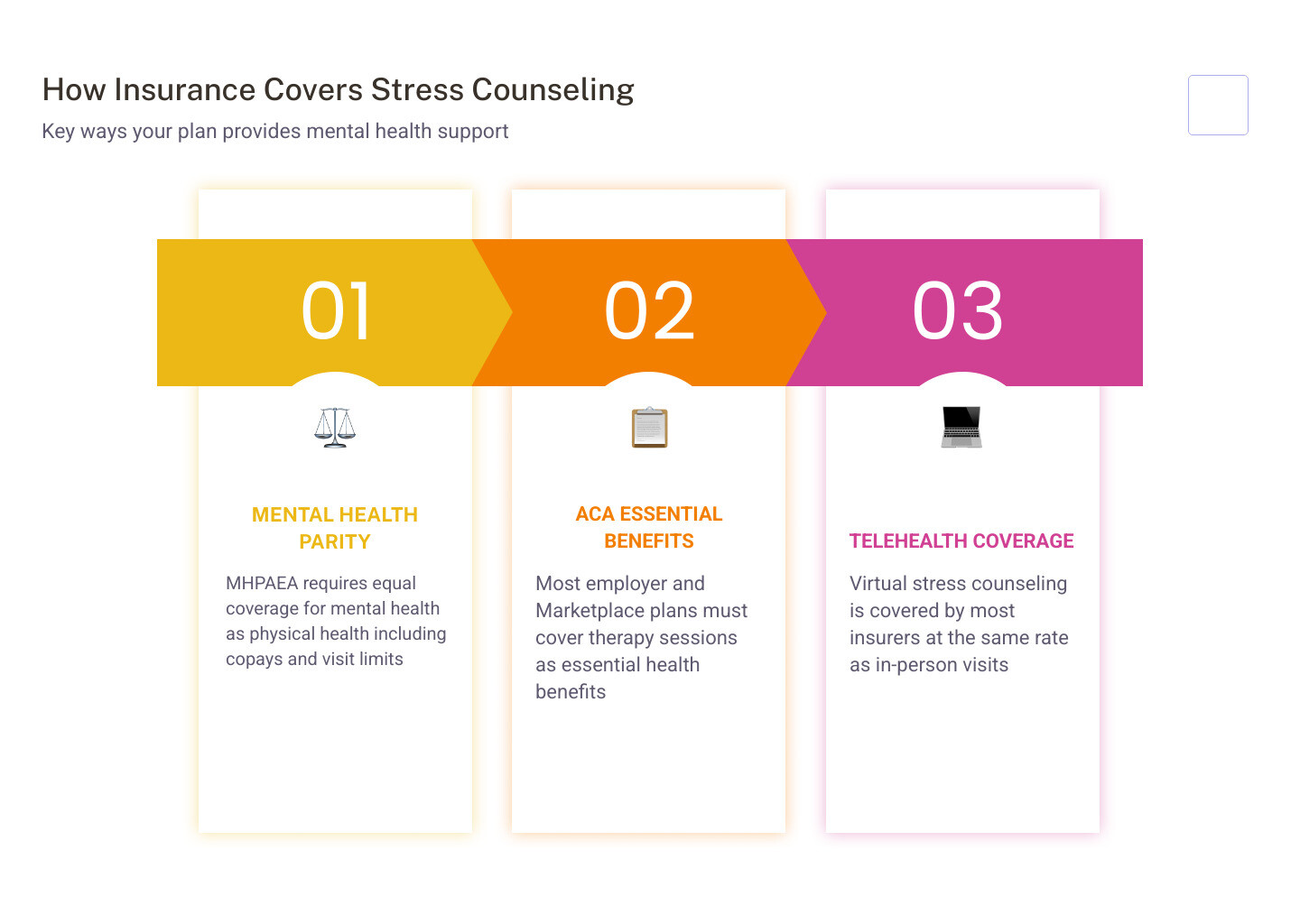
- The Mental Health Parity and Addiction Equity Act (MHPAEA) requires insurers to cover mental health services at the same level as other medical care.
- Your out of pocket costs depend on your plan type, whether your provider is in network, and whether you have met your deductible.
- Telehealth stress counseling is covered by most major insurers at the same rate as in person sessions.
- To confirm your coverage, log in to your insurance member portal or call the member services number on your insurance card.
If you are a busy professional dealing with stress and anxiety, the good news is that you likely do not have to pay full price out of pocket to get help. Over 30% of adults in the United States report symptoms of anxiety or depression, yet many people delay care simply because they are unsure what their insurance will pay for.
The rules around mental health coverage have expanded significantly over the past decade. Both federal law and the Affordable Care Act now require most health plans to treat mental health care the same as physical health care. That means your stress counseling sessions with a licensed therapist are very likely a covered benefit, not an out of pocket luxury.
This guide will walk you through exactly what is covered, how much you can expect to pay, and how to confirm your benefits so you can get started without the guesswork.
Stress Counseling and Mental Health Benefits
When you are looking into whether your mental health benefits will pay for therapy, the legal framework is on your side. Two major pieces of legislation ensure that mental health care is accessible and treated with the same importance as physical health.
First, the Mental Health Parity and Addiction Equity Act of 2008 requires that health insurance plans offering mental health benefits do not impose more restrictive financial requirements or treatment limitations on those services than they do on medical or surgical benefits. This means things like copays, visit limits, and deductibles for mental health visits cannot be more expensive or restrictive than those for your standard doctor visits.
Second, under the Affordable Care Act, mental health and behavioral health services are classified as essential health benefits. This classification applies to all individual and family plans sold through the Health Insurance Marketplace, as well as many employer sponsored plans. Because of these protections, most plans must offer coverage for therapy, making it much easier to find options where your sessions are paid for by your plan.
For a deeper dive into how these laws protect your access to care, you can read more about the general rules in this guide on Does Health Insurance Cover Therapy?. Navigating these benefits might feel confusing at first, but understanding your rights is the first step toward getting the support you deserve. To learn more about how these benefits apply to different plans, you can also check out this overview of Does Insurance Cover Therapy? What You Should Know.
Coverage for Chronic Stress
While the law protects mental health coverage, insurance companies do not automatically pay for every session simply because you feel stressed. To qualify for coverage, the services must be deemed medically necessary. This means a licensed professional must determine that the counseling is required to treat a diagnosed mental health condition.
In insurance billing, everyday stress is usually not a stand alone diagnosis. Instead, chronic stress often manifests as a diagnosable condition recognized in the Diagnostic and Statistical Manual of Mental Disorders. Common diagnoses associated with chronic stress include:
- Adjustment disorders, which occur when someone has an unusually strong or long lasting reaction to a stressful event like a job change or a divorce
- Generalized anxiety disorder, characterized by persistent and excessive worry about various areas of life
- Post traumatic stress disorder, which can develop after experiencing or witnessing a traumatic event
- Major depressive disorder or other mood disorders linked to prolonged periods of severe stress
When a licensed therapist evaluates you and determines that your stress meets the criteria for one of these conditions, they will document a diagnosis. This documentation establishes medical necessity, which allows the therapist to bill your health plan.
If you have a specialized plan, such as military, public, or employer administered coverage, your insurer may use its own medical necessity rules and provider requirements. The best next step is to verify coverage directly through your member portal or by calling the behavioral health number on your insurance card.
How to Verify Your Benefits
Because health plans vary widely, you should always verify your specific benefits before starting your first session. This helps you avoid unexpected bills and ensures you understand your financial responsibilities.
The most reliable way to check your benefits is to log in to your insurance company online member portal. Once logged in, you can search for behavioral health benefits or outpatient mental health services. The portal will show you whether you have met your deductible and what your copay or coinsurance will be.
If you prefer to speak to a representative, call the customer service number on the back of your insurance card. There is often a dedicated number for mental health or behavioral health services. When you call, ask the representative the following questions:
- Does my plan cover outpatient psychotherapy sessions?
- Do I need to meet a deductible before my coverage begins?
- What is my copay or coinsurance for an in network therapy session?
- Do I need prior authorization or a referral from my primary care doctor before scheduling an appointment?
- Are there any limits on the number of sessions covered per calendar year?
Taking a few minutes to verify this information upfront will give you peace of mind as you begin your therapeutic journey. If you are wondering how to navigate this process and find the right professional, you can read this helpful guide on How Can I Find a Therapist That Accepts My Insurance?.
Therapy Types and Coverage Variations

Not all therapy is the same, and different plans cover different modalities. Generally, major health plans cover several types of therapy when they are used to treat a diagnosed condition.
Individual psychotherapy is the most common form of covered care. This involves one on one sessions with a licensed therapist to work through stress, anxiety, or coping strategies. Cognitive behavioral therapy is widely covered because it is an evidence based approach that helps people identify and change negative thought patterns.
Group therapy and family therapy are also commonly covered, especially when involving family members is essential to the patient treatment plan. Additionally, virtual mental health care has become widely accepted. Most insurers now cover telehealth sessions at the same rate as in person visits, making it incredibly convenient to speak with a therapist from the comfort of your home.
To understand how these different modalities fit into standard health plans, review your plan benefits or ask your insurer how outpatient therapy, telehealth, group therapy, and family therapy are handled under your specific policy.
Employer and Marketplace Plans
If you have health coverage through your job or purchased a plan on the health insurance Marketplace, your plan is subject to federal parity laws. This means you have robust mental health benefits built directly into your policy.
Employer sponsored plans, which cover millions of working adults, must provide mental health benefits that align with their medical benefits. This means if your plan offers low copays for visiting a primary care doctor, it must offer comparable copays for visiting an in network therapist.
Marketplace plans, created under the Affordable Care Act, are also required to include mental health and substance use disorder services as essential health benefits. These plans cannot deny you coverage or charge you more simply because you have a pre existing mental health condition.
For commercial plans, the most useful next step is to confirm whether outpatient therapy is covered, whether your therapist must be in network, and whether any referral or prior authorization is required before your first session.
Medicare and Medicaid Coverage
For individuals who rely on public health programs, both Medicare and Medicaid offer essential mental health benefits, though their rules and provider networks differ from private insurance.
Medicare Part B covers outpatient mental health services, including individual and group therapy sessions, family counseling, and psychiatric evaluations. To have your sessions covered, you must see a provider who accepts Medicare. Eligible providers include clinical psychologists, clinical social workers, marriage and family therapists, and mental health counselors. You can review the exact billing and provider guidelines through official Medicare resources or your plan administrator.
Medicaid benefits vary by state, but federal law requires all state Medicaid programs to cover basic mental health services. Most Medicaid plans cover outpatient therapy with little to no out of pocket cost for eligible individuals. However, finding a local therapist who accepts Medicaid can sometimes require extra research, as networks can be limited.
Out of Pocket Costs and Network Status

Even when stress counseling is covered by your health plan, you will likely still have some out of pocket expenses. Understanding how your plan handles these costs will help you budget for your care.
Your primary out of pocket expenses will fall into three categories:
- Deductibles: This is the amount of money you must pay for medical care before your insurance company starts paying. If you have a high deductible plan, you may have to pay the full negotiated rate for your therapy sessions until you meet that threshold.
- Copays: A copay is a fixed flat fee you pay at the time of your visit. For example, you might pay a set amount for each therapy session, and your insurance covers the rest.
- Coinsurance: This is a percentage of the total cost of the session that you are responsible for paying. For example, if your plan has a twenty percent coinsurance, you pay that percentage of the session cost, and your insurer pays the remaining eighty percent.
These cost sharing details can vary significantly from plan to plan, so your member portal or insurance card is the best place to confirm the exact amount you may owe for each session.
In Network versus Out of Network Providers
One of the biggest factors determining your out of pocket cost is your therapist network status.
In network therapists have signed contracts with your insurance company. They agree to accept a pre negotiated, lower rate for their services. When you see an in network provider, your insurance covers a larger portion of the bill, resulting in the lowest possible cost for you.
Out of network therapists do not have a contract with your insurer. If you choose to see an out of network provider, your insurance may cover only a small portion of the cost, or they may not cover it at all. Some plans allow you to submit a superbill, which is a detailed invoice provided by your therapist, to your insurance company for partial reimbursement. However, you will still end up paying more than if you stayed in network.
If you are considering an out of network therapist, ask your insurer whether your plan includes reimbursement benefits and what documentation you would need to submit after each session.
Session Limits and Prior Authorization
Some health plans place limits on the number of therapy sessions they will cover within a single calendar year. If your plan has a session cap, you may need to request additional sessions once you reach that limit.
To get additional sessions approved, your therapist will need to submit medical necessity documentation to your insurance company. This documentation explains why ongoing therapy is clinically necessary for your continued progress and well-being.
Additionally, some plans require prior authorization before you even begin therapy. This means your insurer must review and approve your treatment plan before they agree to pay for your sessions. Always check with your insurance company beforehand to see if prior authorization is required so you do not get stuck with unexpected bills.
Frequently Asked Questions
Does insurance cover online stress counseling?
Yes, most major health insurance plans cover online stress counseling, also known as telehealth or teletherapy. Under federal and state regulations, many plans are required to cover virtual visits at the same rate as in-person sessions. This means your copay, coinsurance, and deductible requirements will remain the same whether you see your therapist in an office or online. Always confirm with your provider and your insurer that the telehealth platform they use is approved by your plan.
What should I do if my insurance denies stress counseling coverage?
If your insurance company denies coverage for your stress counseling, you have options. First, you can appeal the decision. Your therapist can help by providing medical records and a letter of medical necessity to show that your treatment is clinically required. If the appeal is not successful, ask your therapist if they offer a sliding scale fee structure, which adjusts the session cost based on your income. You can also ask about flexible payment plans to help make the cost of care more manageable.
Can I use a health savings account for stress counseling?
Yes, you can absolutely use a Health Savings Account (HSA) or a Flexible Spending Account (FSA) to pay for stress counseling. Therapy and psychiatric services are considered qualified medical expenses by the IRS. You can use your HSA or FSA debit card to pay for copays, coinsurance, deductibles, or even the full cost of sessions if you are paying out of pocket. This is a great way to use pre-tax dollars to lower your overall healthcare expenses.
Conclusion
Managing chronic stress is vital for your long-term health, and utilizing your insurance benefits makes professional support much more accessible. Navigating deductibles, networks, and medical necessity can feel overwhelming, but you do not have to do it alone.
Collective Counseling Solutions connects clients with licensed therapists who accept insurance, offering both in-person and teletherapy options. They simplify the process of accessing skilled, insurance-accepting therapists, helping you focus on your healing journey rather than administrative headaches.
Ready to connect with someone who accepts your insurance? Find a therapist through Collective Counseling Solutions and take the next step toward support that fits your needs.
If you are ready to take the next step toward managing your stress with a professional who fits your budget and your life, explore your options for Therapy for Stress today.