

Understanding the Science: How EMDR for Depression Works
Eye Movement Desensitization and Reprocessing, commonly known as EMDR, is an evidence based psychotherapy method designed to help the brain reprocess stuck, distressing life events. While originally developed to treat post traumatic stress, mental health professionals increasingly recognize how underlying adverse life events and factors that lead to depression can be resolved using this specialized approach.
The Adaptive Information Processing Model and Pathogenic Memories
At the heart of EMDR is the Adaptive Information Processing model. This model posits that the human brain naturally processes difficult experiences toward emotional health and resolution. However, when an individual encounters intense emotional distress, chronic neglect, or significant life upheavals, this natural processing system can become overwhelmed.
Instead of being integrated into standard memory networks, these stressful events get stored in an isolated, dysfunctionally recorded state. These unprocessed experiences are known as pathogenic memories. When current events trigger these stored memories, a person re experiences the old emotional pain, physical tension, and distorted self beliefs as if the event were still happening today. In depression, these memories often manifest as deep feelings of helplessness, worthlessness, or chronic emotional numbness.
Proposed Neurobiological Mechanisms in the Brain
EMDR utilizes dual attention bilateral stimulation, which involves side to side eye movements, alternating auditory tones, or rhythmic tactile taps while focusing on a target memory. Scientific literature, including a systematic review on trauma focused treatments for depression, highlights several proposed explanations for how this process may affect depressive symptoms. Researchers have proposed several mechanisms that may contribute to EMDR’s effects, although no single neurobiological explanation has been conclusively established.
- Prefrontal Cortex Activation: Some neuroimaging research suggests changes in activity involving brain regions associated with emotional regulation, although these findings remain preliminary.
- Working Memory Taxation: Holding a vivid memory in mind while tracking bilateral movement taxes working memory capacity. This dual task may reduce the emotional vividness of the memory and may support reprocessing in a less distressing form.
- Superior Colliculus and Thalamic Pathways: Some researchers have proposed that alternating sensory cues may engage neural circuits involved in orienting responses and feelings of safety. This remains a proposed explanation rather than an established pathway for EMDR’s clinical effects.
- REM Sleep Analogy: The lateral eye movements have been compared with the rapid eye movements that occur during REM sleep, a stage associated with memory consolidation and emotional processing. This is a hypothesis and analogy, not evidence that EMDR and REM sleep work through the same mechanism.
Treating Depression Without a History of Severe Trauma
A common misconception is that EMDR requires a person to have survived a severe or catastrophic event. Depression can develop through a complex combination of biological, psychological, social, and environmental factors. For some people, cumulative stressful or adverse experiences may contribute to depressive symptoms even when there is no history of a single catastrophic trauma.
Experiences such as persistent childhood emotional invalidation, painful breakups, bullying, sudden financial instability, or severe workplace humiliation can deeply alter how individuals view themselves and the world. Over time, these experiences may contribute to recognizable signs and symptoms of depression, such as low energy, persistent sadness, and negative self-talk. EMDR helps clients target and neutralize these everyday relational wounds, freeing them from their emotional weight.
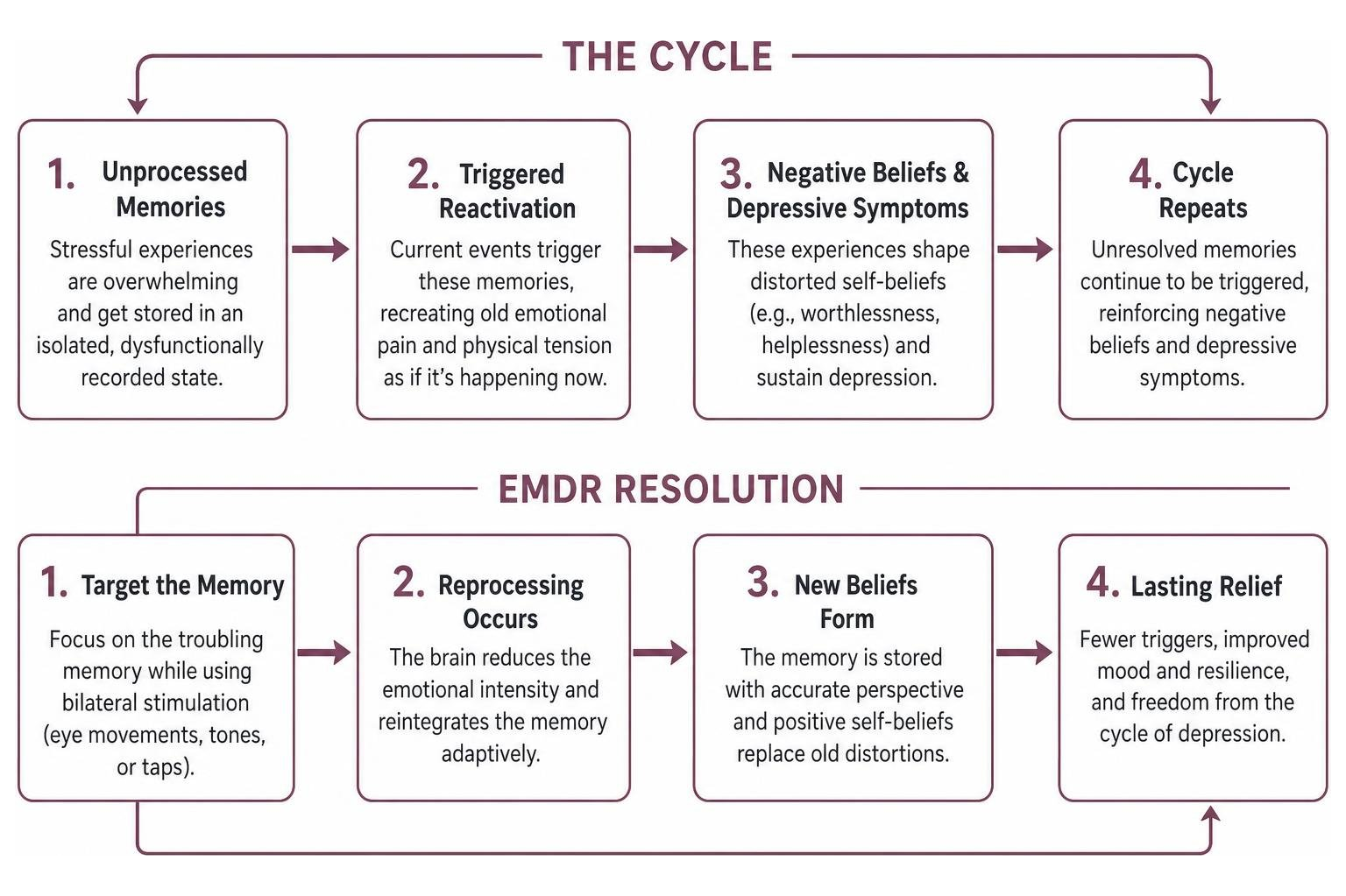
The Evidence Base: Clinical Effectiveness, Remission, and Relapse Rates
Research into trauma informed care for mood disorders has expanded rapidly. Clinical studies demonstrate that targeting distressing memories can produce substantial and lasting improvements in mood regulation.
What Clinical Studies Say About EMDR for Depression
A comprehensive meta analysis on EMDR efficacy evaluating multiple randomized controlled trials found that EMDR produces significant reductions in depressive symptoms, with larger effect sizes observed in individuals experiencing more severe baseline depression.
A follow up study of depression remission in an inpatient setting reported encouraging outcomes after discharge. However, it was a small observational study in which EMDR was part of a broader treatment program. Its results cannot establish that EMDR alone caused remission or reduced the likelihood of future depressive episodes.
Comparing EMDR and Cognitive Behavioral Therapy
Both Cognitive Behavioral Therapy (CBT) and EMDR are respected, research supported treatments for mood disorders, but their therapeutic mechanisms differ significantly. The EDEN randomized controlled trial found that both EMDR and CBT, when added to antidepressant medication, significantly reduced depressive symptoms. Remission rates did not differ significantly between the groups at the end of treatment or at follow up, although EMDR participants had lower depression symptom scores immediately after treatment.
| Clinical Feature | Cognitive Behavioral Therapy (CBT) | Eye Movement Desensitization and Reprocessing (EMDR) |
|---|---|---|
| Primary Focus | Identifying and restructuring conscious negative automatic thoughts | Reprocessing dysfunctionally stored memories and underlying emotional nodes |
| Therapeutic Process | Socratic dialogue, behavioral experiments, and thought records | Dual attention bilateral stimulation combined with somatic tracking |
| Homework Demands | Regular daily worksheets, activity scheduling, and behavioral logs | Minimal between session homework; focus remains on real time in session processing |
| Role of Past Events | Examines past schemas to understand current cognitive patterns | Directly targets specific past memories to clear their somatic and emotional charge |
| Relapse Prevention | Teaching conscious coping strategies for future cognitive distortions | Installing adaptive self beliefs and mentally rehearsing future triggers |
The 8 Phase Treatment Protocol and What to Expect
EMDR is not a random collection of eye movements. It is an eight phase psychotherapy protocol that follows a three pronged approach: targeting past memories, present day triggers, and future scenarios. Understanding what depression therapy is really like when utilizing EMDR helps demystify the healing process.
Phases of EMDR Therapy for Depressive Symptoms
- History Taking and Treatment Planning: The therapist and client explore the client’s background, identifying specific depressive triggers, current symptoms, and foundational memories that seem to hold negative self beliefs in place.
- Preparation and Resource Building: The therapist introduces grounding techniques, self soothing tools, and emotional stabilization skills to ensure the client feels safe, grounded, and in control before any memory processing begins.
- Assessment: The specific target memory is identified, along with its vivid mental image, the negative belief it supports (such as “I am inadequate”), the desired positive belief (such as “I am capable and worthy”), the current emotions, and where physical sensations are felt in the body. Baseline measurements are recorded using the Subjective Units of Disturbance scale and the Validity of Cognition scale.
- Desensitization: The client focuses on the memory while engaging in bilateral stimulation sets. The therapist periodically pauses to check in, allowing the client’s brain to naturally shift associations, release emotional pain, and decrease subjective distress.
- Installation: Once distress around the memory is cleared, bilateral stimulation is used to strengthen and integrate the positive belief, ensuring it feels deeply true on both an intellectual and emotional level.
- Body Scan: The client mentally scans their physical body while thinking of the original memory and positive belief to identify and release any remaining somatic tension, tightness, or discomfort.
- Closure: Each session concludes with grounding exercises, ensuring the client returns to an emotionally stable state before leaving, whether reprocessing is complete or ongoing.
- Reevaluation: At the beginning of the next session, the therapist checks previous targets to confirm that distress remains low and positive changes have generalized to daily life.
Modifying Core Beliefs and Relapse Prevention
Depression frequently locks individuals into harsh, rigid cognitive scripts. Through EMDR, clients transform self demeaning perceptions into compassionate, adaptive truths.
To ensure long term resilience, therapists utilize future templates. During this stage, clients mentally rehearse navigating potential depressive triggers, such as setting boundaries, facing a difficult anniversary, or handling workplace criticism, while holding positive self beliefs and maintaining a calm nervous system.
Navigating Your Treatment: How to Find the Right Therapist
Choosing the right clinician is an essential step in finding meaningful relief from depressive symptoms. Learning how to find a therapist who is right for me involves verifying credentials, assessing professional rapport, and confirming specialized training in mood disorders.
Key Questions to Ask Your Therapist About EMDR for Depression
- What formal EMDR training and certifications have you completed through recognized professional bodies?
- How much experience do you have in adapting the standard EMDR protocol specifically for depression and mood disorders?
- How do you approach emotional preparation and stabilization before starting memory reprocessing?
- Do you screen for dissociation and emotional tolerance prior to beginning bilateral stimulation?
- How do we pace sessions to ensure I feel emotionally safe and grounded throughout our work together?
Practical Considerations and Managing Between Session Distress
Because EMDR accesses stored emotional material, clients may occasionally notice vivid dreams, emotional shifts, or physical fatigue between appointments. A skilled therapist will provide clear grounding protocols to manage these transient experiences safely.
Additionally, navigating logistics such as session formats and benefits is an important practical step. Many clients choose between in person sessions and virtual teletherapy, both of which demonstrate strong clinical efficacy. Understanding your coverage by verifying insurance coverage for therapy ensures your care remains accessible, predictable, and stress free throughout your healing journey.
Frequently Asked Questions About EMDR Therapy
Can EMDR help if I do not remember a specific trauma?
Yes. EMDR does not require clear recall of a single dramatic event. Depressive states are frequently tied to implicit emotional memories, general themes of loneliness, or chronic family instability. A therapist can use current feelings, negative self beliefs, or somatic body sensations as starting points to access and reprocess these broader emotional networks.
How many sessions does EMDR usually take for depression?
The duration of EMDR therapy varies based on individual history and treatment goals. While processing an isolated stressful event may take several sessions, individuals working through recurrent depression, chronic childhood neglect, or layered relational challenges may benefit from a longer course of care integrated with ongoing therapeutic support.
Is EMDR safe to combine with antidepressant medication?
Yes. EMDR can be used alongside antidepressant medication when appropriate. Whether medication is part of treatment depends on the individual’s symptoms, medical history, preferences, and treatment plan. Clients taking psychiatric medication should continue working with their prescribing healthcare professional regarding medication decisions.
Conclusion
Depression can feel like an unending cycle of exhaustion, self doubt, and emotional heaviness. However, modern clinical approaches show that when the underlying experiences feeding these patterns are addressed, real and lasting recovery is possible.
Collective Counseling Solutions helps individuals break free from these cycles by simplifying access to skilled, compassionate clinicians. Whether you prefer in person sessions or flexible virtual care, we match you with licensed professionals who accept insurance and specialize in personalized evidence based treatments. Explore our dedicated options for therapy for depression to connect with a therapist who can help you reprocess the past and build a grounded, fulfilling future.