

Find the Right Support for Relationship Stress
Individual relationship counseling is one on one therapy that helps you understand your patterns in relationships and build practical skills for communication, trust, boundaries, and emotional regulation. It can help whether you are dating, partnered, healing from a breakup, or dealing with difficult family, friendship, or work dynamics.
To find a local therapist who fits your needs, look for:
- A licensed clinician with experience in relationship concerns
- In person or teletherapy options that work with your schedule
- A clear approach to issues such as anxiety, conflict, people pleasing, or past betrayal
- Insurance information and a simple way to ask about fit before starting
You do not need a partner in the room to make meaningful change. When you better understand your reactions, express needs clearly, and set healthier limits, the relationship system around you can change too.
Understanding Individual Relationship Counseling and How It Works
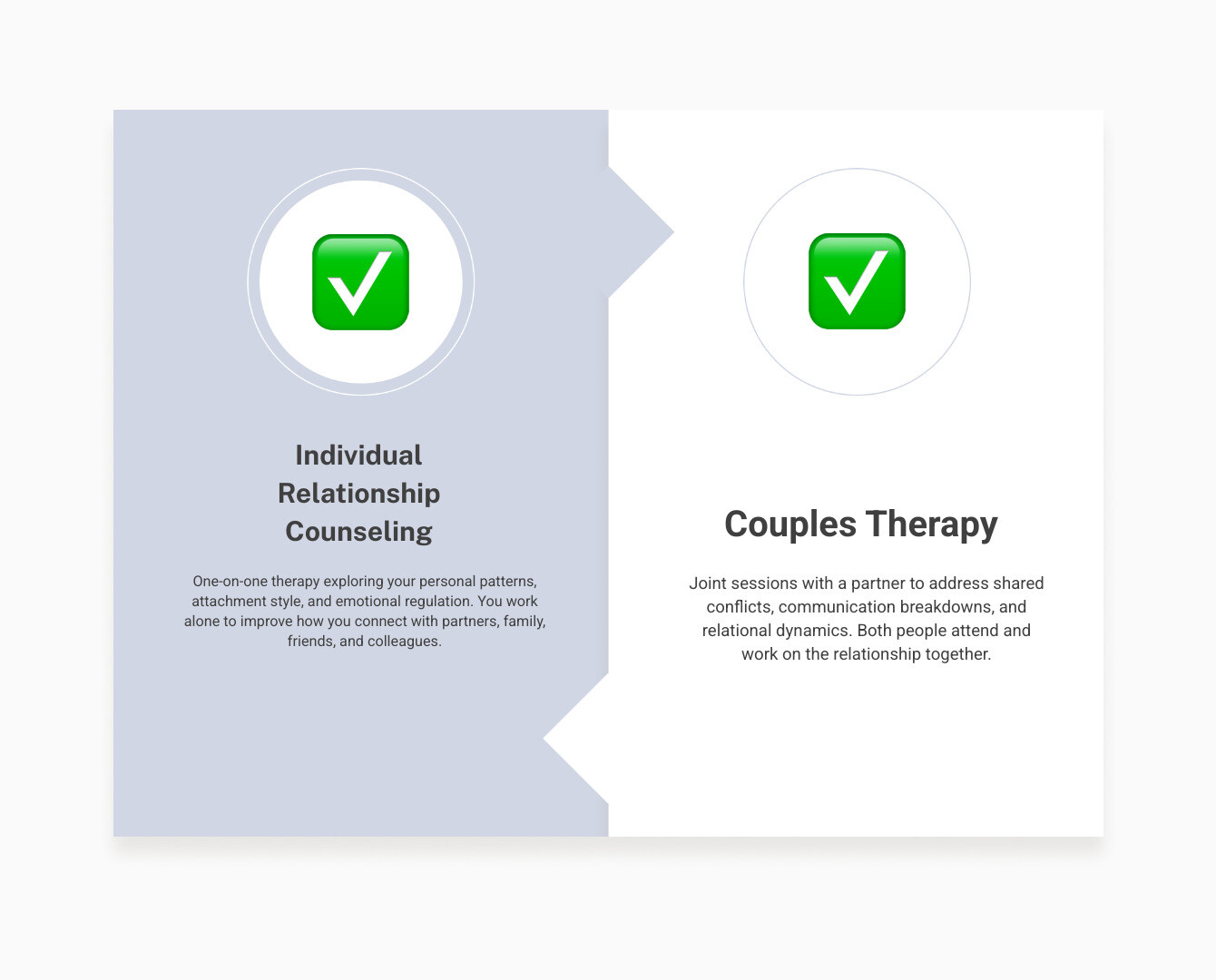
When people think about relationship therapy, they usually picture two partners sitting on a couch, debating past arguments in front of a neutral counselor. While joint therapy is incredibly effective, what happens in couples therapy is only one path toward relational health.
Individual relationship counseling focuses entirely on your personal experience within your connections. Through a one on one format, you explore your attachment style, emotional regulation tools, and the family blueprints that guide how you love, argue, and connect with others.
Relationships operate as emotional systems. When one person changes how they respond, set boundaries, or communicate, the entire dynamic must shift in response. Individual counseling allows you to examine your internal world without the pressure of managing someone else’s immediate reactions.
| Feature | Individual Relationship Counseling | Traditional Couples Therapy |
|---|---|---|
| Primary Focus | Personal patterns, emotional reactions, attachment history, and self boundaries | Interactive communication patterns, shared conflict cycles, and mutual goals |
| Participants | You and your licensed therapist | You, your partner, and your licensed therapist |
| Expression Style | Completely unfiltered, with no need to protect a partner’s feelings | Collaborative dialogue guided in real time to facilitate empathy |
| Session Goals | Internal security, boundary setting, self differentiation, and personal healing | Mutual understanding, deescalation, conflict resolution, and shared connection |
| Ideal Contexts | Solo reflection, breakup recovery, dating anxiety, family stress, or partner refusal | Joint commitment to improving an existing partnership |
How Individual Relationship Counseling Differs from Couples Therapy
The most significant distinction between solo counseling and couples therapy lies in the emotional safety of unedited self expression. In joint sessions, people frequently filter their thoughts to avoid hurting their partner or sparking a fresh argument on the car ride home.
In individual relationship therapy, you have complete freedom to share fears, resentments, and doubts without editing. You can process past personal trauma, explore unresolved childhood experiences, and build internal security before addressing shared concerns.
Who Benefits Most from Individual Relationship Counseling
Relationship counseling in an individual format serves a wide variety of relational needs:
- Partners navigating unilateral change: If your significant other refuses to attend therapy, solo work gives you clarity, emotional steadiness, and boundary tools.
- Singles and daters: Exploring your patterns while single provides mental clarity without active relationship triggers.
- Individuals recovering from a breakup or divorce: Solo therapy creates space to grieve, rebuild self worth, and avoid repeating old relationship traps.
- People struggling with codependency: If you tend to lose yourself in others, individual work strengthens your sense of self.
When deciding on treatment structures, evaluating individual vs. group therapy options can also help you determine the best level of community support for your goals.
Key Issues Addressed in Individual Relational Therapy

Individual relationship therapy targets the root causes of recurring interpersonal friction. Research shows that roughly 15 to 20 percent of adults enter individual therapy specifically to resolve relationship concerns.
Working with a therapist one on one helps resolve several core relational challenges:
- Relationship anxiety and overthinking: Constant worries about whether a partner might leave or dissecting text messages can be exhausting. Studies indicate that focusing on attachment patterns in therapy can reduce relationship anxiety by up to 50 percent over 12 to 16 sessions.
- Infidelity and trust rebuilding: If you have experienced betrayal, individual therapy provides a safe space to process hypervigilance, grief, and anger without having to manage your partner’s guilt or defensiveness.
- People pleasing and poor boundaries: Over 60 percent of clients in individual relationship counseling report meaningful improvements in setting healthy boundaries within six months.
Navigating Communication and Conflict Resolution Solo
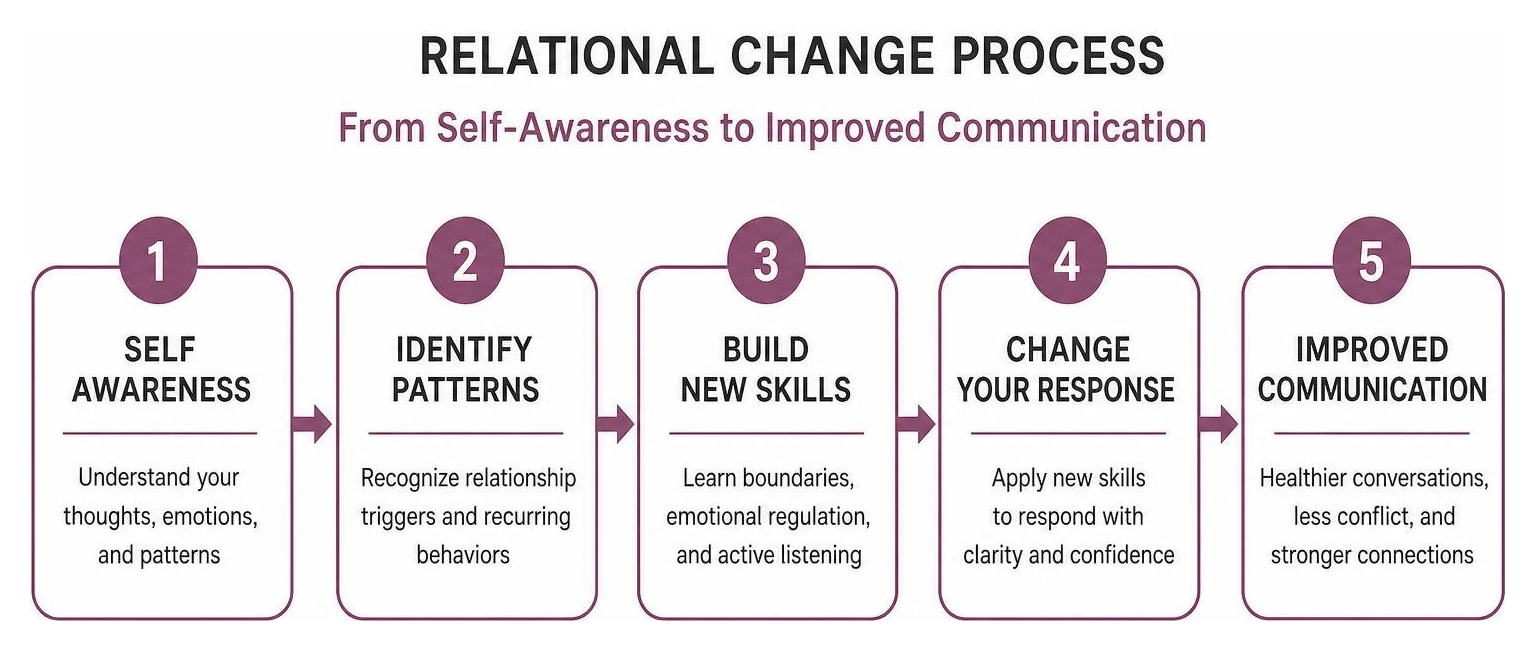
You do not have to wait for your partner to join you to change how arguments unfold. Learning deescalation techniques, identifying personal defensiveness, and practicing active listening can transform high conflict dynamics from the inside out.
While targeted couples therapy for communication and specialized couples therapy for conflict resolution are ideal when both partners are ready, individual work teaches you how to stop participating in destructive cycles independently.
Healing Attachment Wounds, Family Dynamics, and Workplace Stress
The relational habits you develop in childhood with primary caregivers create foundational templates for adult life. If conflict was unsafe in your childhood home, you might shut down or become overly accommodating as an adult.
Individual counseling helps you examine these family of origin patterns so they stop dictating your adult life. The skills you develop transfer seamlessly beyond romance, helping you manage difficult parents, establish limits with overbearing friends, and communicate assertively with colleagues or managers at work.
Checklist for Choosing a Local Relationship Therapist
Finding the right clinician is essential for effective care. Use this checklist to evaluate potential therapists and find the right match for your goals.
- Verify Licensure and Credentials
- Confirm the clinician holds an active license such as an LMFT, LCSW, LPC, or licensed psychologist.
- Ensure they have specific training and experience in relational systems and attachment theory.
- Confirm Insurance and Payment Compatibility
- Check whether the provider accepts your insurance plan to keep ongoing therapy sustainable.
- Work with practices that verify benefits upfront so you understand your coverage clearly.
- Review the Therapist’s Clinical Modality
- Ask if they integrate approaches like Cognitive Behavioral Therapy, Emotionally Focused Therapy, or psychodynamic frameworks adapted for individuals.
- Evaluate Delivery Format Options
- Determine whether you prefer the focus of in person sessions or the convenience of secure teletherapy appointments.
- Assess Relational Alignment and Comfort
- Schedule an initial consultation to gauge whether you feel respected, heard, and supported in their presence.
Assessing Modalities and Theoretical Approaches
Therapists draw from several evidence based modalities to help you reach your goals:
- Emotionally Focused Therapy (EFT) for Individuals: Helps you identify unmet emotional needs and shift anxious or avoidant responses into secure connection habits.
- Internal Family Systems (IFS): Explores protective parts of yourself, such as people pleasing or emotional withdrawal, to help you respond to others with calm confidence.
- Cognitive Behavioral Therapy (CBT): Identifies cognitive distortions, like assuming the worst or mind reading, that cause unnecessary relationship friction. Research highlighted by the American Psychological Association demonstrates how cognitive strategies support lasting emotional health.
- Psychodynamic Therapy: Examines early relational templates and unconscious defenses to help you break long standing relationship patterns.
Deciding Between Individual Sessions and Joint Counseling
Choosing between individual and couples therapy depends on your current situation. Understanding is it healthy to go to couples therapy helps clarify the collaborative benefits of joint sessions. Similarly, reviewing common signs you need couples therapy can help you determine whether your partner is ready to participate.
Individual therapy is usually the better choice when you need to process personal trauma, when safety or severe emotional distress makes joint dialogue unhelpful, or when you need clarity about whether you want to remain in the relationship. Many individuals also pursue solo sessions alongside couples counseling for comprehensive support.
Frequently Asked Questions About Individual Relationship Therapy
Can individual relationship therapy help if my partner refuses to participate?
Yes. Because relationships are interconnected systems, changing your communication, emotional regulation, and boundaries naturally shifts how your partner interacts with you. It also gives you a clear space to decide your long term path forward.
Do I need to be currently dating or married to start relationship therapy?
Not at all. Starting relationship therapy while single offers the valuable benefit of working through past patterns, healing from past breakups, and clarifying your values without the immediate stress of an active conflict.
What should I expect during a typical session?
Initial sessions focus on your relational history, family background, and current challenges. Ongoing sessions combine reflective discussion with actionable tools, communication practice, and boundary exercises tailored to your weekly life.
Conclusion

Healthy relationships start with self awareness, emotional balance, and clear boundaries. Whether you are navigating a difficult partnership, healing from a painful breakup, or preparing for future love, you have the power to create lasting change.
Collective Counseling Solutions simplifies your journey by connecting you with skilled, licensed therapists who accept insurance for both in person and teletherapy care. Take the first step toward stronger connections and find a therapist who meets your needs today.