

Are Psychologists Covered by Insurance? Laws and Coverage Rules
Understanding the regulations that govern mental healthcare is the easiest way to clarify how benefits work. People often ask whether their insurance will treat a visit to a mental health professional differently than a trip to a specialist for physical health. Federal laws provide important protections for mental health coverage in many health plans, although the specific benefits available depend on the type of plan and its terms.
When exploring understanding therapy insurance, you will find that coverage relies on federal equity standards and baseline benefit rules. Under the Affordable Care Act, mental and behavioral health services qualify as ACA essential health benefits. This categorization ensures that comprehensive individual and small employer plans cannot simply opt out of offering behavioral healthcare.
Federal Protections: Mental Health Parity and ACA Standards
The bedrock of behavioral healthcare equity in the United States is the Paul Wellstone and Pete Domenici Mental Health Parity and Addiction Equity Act. According to mental health parity guidelines, health plans that offer mental health benefits cannot place harsher financial or clinical limitations on those services than they do on general medical care.
Historically, health plans often charged higher fees or placed arbitrary session caps on psychological treatment. Parity legislation addresses this directly by prohibiting two distinct types of restrictions:
- Quantitative treatment limits: For plans subject to MHPAEA, numerical treatment limits, such as annual visit limits, on mental health benefits generally cannot be more restrictive than the limits permitted for comparable medical/surgical benefits within the same benefit classification.
- Nonquantitative treatment limits: Health plans cannot establish stricter medical management standards, preauthorization criteria, or network admission requirements for behavioral health providers than for physical medical providers.
Public awareness of these protections has grown over time. According to research from the American Psychological Association, more than 90 percent of Americans were unfamiliar with the mental health parity law when it was first being implemented. Today, these parity protections provide consumers with a legal basis to challenge unfair restrictions or benefit denials.
How Plan Types Determine If Are Psychologists Covered by Insurance
While federal regulations set baseline expectations, the specific structure of your plan dictates how services are reimbursed.
Even though many plans technically provide behavioral health benefits, whether psychologists are covered by insurance in daily practice often depends on provider network participation.
Understanding Therapy Costs: In Network vs. Out of Network Expenses
The total amount you pay out of pocket for a session is primarily decided by your provider’s network status. Health insurance companies build networks by contracting with psychologists who agree to accept fixed, predetermined rates for clinical services.
Before scheduling your initial visit, verifying mental health benefits directly with your plan helps ensure you avoid unexpected balance billing.
Copays, Deductibles, and Coinsurance Explained
Health insurance terminology can feel like learning a second language. Here is a clear breakdown of the three key terms that determine your visit costs:
- Deductible: The amount you must pay for covered services each calendar year before your health insurance begins sharing costs. For plans subject to MHPAEA, separate cumulative financial requirements, such as a deductible that applies only to mental health or substance use disorder benefits, generally are not permitted.
- Copayment: A set, flat fee you pay at the time of each visit once any applicable deductible is met. For example, a plan might assign a specialist copayment for every psychology visit.
- Coinsurance: A fixed percentage of the total allowed visit fee that you pay after satisfying your annual deductible, with the insurance plan covering the remaining percentage.
Certain plans also establish an annual out-of-pocket maximum. Once you reach your plan’s applicable out-of-pocket maximum, the plan generally pays 100% of covered in-network benefits for the remainder of the plan year. Check your plan documents to determine which expenses count toward that limit.
Navigating Out of Network Reimbursement and Superbills
If your chosen psychologist does not participate directly in your health plan’s network, you may still be able to access out of network benefits. This path involves paying the clinician directly at the time of service and seeking partial reimbursement from your insurance company afterward.
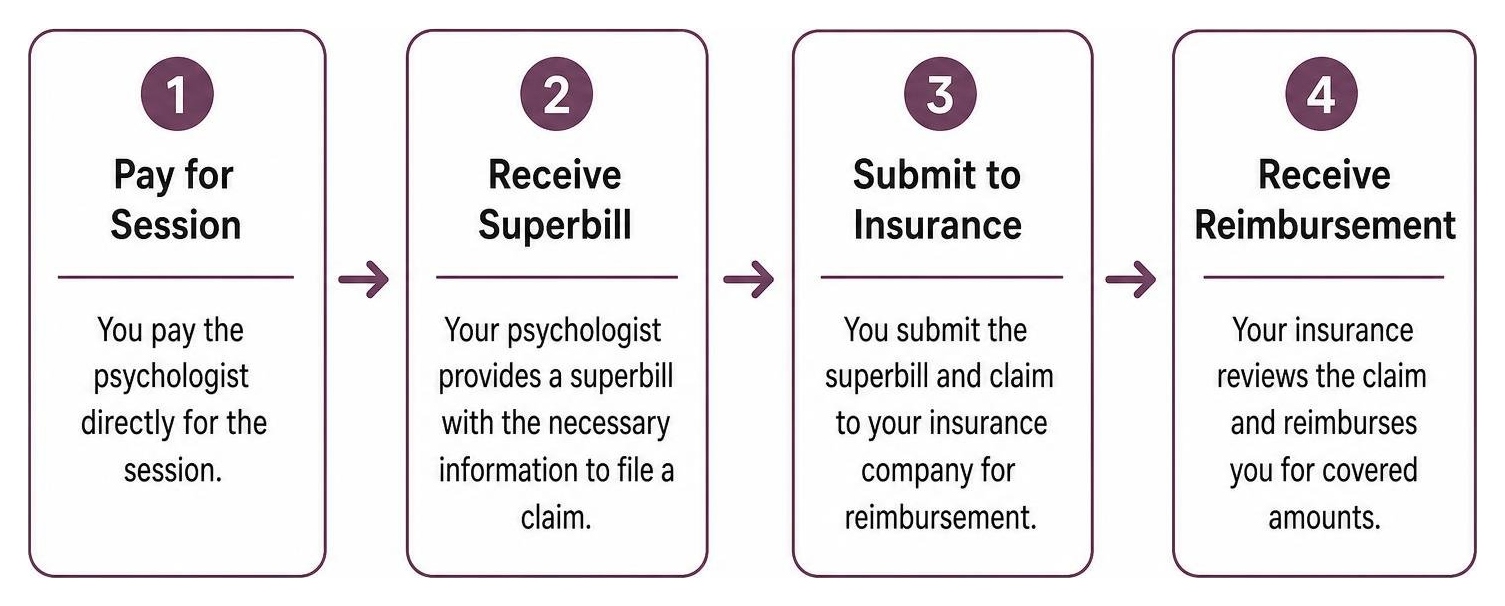
To file for out of network reimbursement, request a superbill from your clinician. A superbill is a comprehensive medical invoice that includes:
- The psychologist’s professional license number and National Provider Identifier
- Standard procedure coding representing the length and format of the session
- Relevant clinical diagnostic codes establishing medical necessity
- Dates of service, location details, and payment verification
You then submit this document alongside a standard claim form through your insurance portal or by mail. Your insurer will process the claim according to your plan’s out-of-network reimbursement rules. The amount reimbursed can depend on the plan’s allowed amount, deductible, coinsurance, and other plan-specific provisions.
Why Many Psychologists Choose Not to Accept Insurance
When looking for a psychologist, many individuals notice that independent practitioners frequently operate on a self pay basis. According to data reported by Vox, a third of psychologists do not take insurance at all, and fewer than 40 percent of therapists are in network with any single health plan.
This dynamic creates significant obstacles for people seeking care. A healthcare survey highlighted by LegalClarity revealed that more than half of Americans surveyed said treatment costs were a major barrier to care, and four in ten people noted that provider scarcity was a substantial obstacle.
Learning more about therapists opting out of insurance reveals the administrative and systemic factors behind this trend.
Stagnant Reimbursement Rates and Administrative Overhead
The primary reason many clinical psychologists choose not to contract with insurance companies comes down to simple practice sustainability. Professional analyses from the American Psychological Association point out that many insurance companies have not increased reimbursement rates for psychologists in ten or even twenty years.
At the same time, the administrative overhead required to process claims, navigate preauthorizations, and manage delayed payments has risen considerably. For independent practitioners, spending several unpaid hours each week managing claim disputes can take away from direct client care. This disconnect has led to the rise of ghost networks, which are official insurance directories that list providers who are full, no longer taking insurance, or retired.
Diagnostic and Medical Necessity Mandates: How Are Psychologists Covered by Insurance
Another reason some psychologists prefer private pay arrangements is the strict diagnostic requirement enforced by health insurance carriers. To approve reimbursement for therapy, health plans require clinicians to establish clinical medical necessity.
This means your psychologist must assign a formal diagnosis from the Diagnostic and Statistical Manual of Mental Disorders. For instance, insurance routinely covers structured care like therapy for anxiety coverage or evidence based depression treatment coverage because these clinical conditions meet standard necessity criteria.
If an individual attends therapy exclusively for personal growth, career decision making, or general self exploration, insurance companies often view the sessions as non clinical and will deny coverage.
How to Find a Psychologist Who Accepts Your Insurance
Finding an available, qualified clinician who accepts your plan does not have to be an exhausting process. Connecting with specialized networks that partner with licensed providers makes it easier to match with professionals who fit your scheduling, clinical, and insurance preferences.

Exploring guides on finding insured therapists will give you a practical blueprint for beginning your search.
Verifying Benefits and Asking Key Provider Questions
Before attending your first intake appointment, take ten minutes to call the member services phone number on the back of your insurance card. You can use this checklist to ensure you collect all the essential billing details:
- Does my plan cover outpatient psychotherapy with a licensed clinical psychologist?
- What is my copayment or coinsurance percentage per individual therapy session?
- Do I need to meet an annual deductible before my psychotherapy benefits apply?
- Do my benefits require a formal referral from a primary care physician or preauthorization?
- Is telehealth psychotherapy covered at the same financial rate as in person visits?
- What is the claim submission deadline for out of network reimbursement?
Low Cost Alternatives, Telehealth, and Community Care
If your insurance plan has a high deductible or you are seeking care without active coverage, several community and clinical resources can help keep therapy accessible:
- Sliding scale counseling: Many private practice clinicians allocate a portion of their caseload to reduced-fee arrangements adjusted to your household income.
- University training clinics: Universities with doctoral psychology programs frequently run community outpatient clinics where advanced graduate clinicians provide high-quality, supervised care at accessible rates.
- Certified Community Behavioral Health Clinics: These community centers provide comprehensive, low-cost mental healthcare regardless of insurance status.
- Employee Assistance Programs: Some employers offer short-term counseling through an EAP, often at no direct cost to the employee. The number of available sessions and covered services varies by program.
- Statewide telehealth access: Virtual care allows you to connect with licensed psychologists across your entire state, widening the pool of available in-network clinicians.
Support from loved ones, community groups, and lifestyle adjustments can also enhance your wellness journey alongside individual care.
Frequently Asked Questions About Mental Health Insurance
What should I do if my mental health insurance claim is denied?
If an insurance claim is rejected, first examine your Explanation of Benefits document to find the specific denial code. Denials often happen due to simple administrative errors, such as a mistyped birthdate, an incorrect National Provider Identifier, or missing diagnostic coding.
If the denial is based on a lack of medical necessity, you have the legal right to file an internal appeal. Ask your psychologist to provide a formal letter of medical necessity detailing your treatment plan and clinical progress. If your internal appeal is upheld and you believe your plan is imposing stricter limits on mental healthcare than physical healthcare, you can submit an external review request through your state insurance commissioner or the federal Department of Labor.
Do I need a primary care physician referral to see a psychologist?
Referral requirements depend on your plan type. Preferred Provider Organization plans typically allow you to schedule appointments directly with an in network psychologist without a referral. Health Maintenance Organization and Point of Service plans frequently require a referral from your primary care doctor before covering specialist visits. Always confirm your plan rules before booking to prevent unexpected out of pocket charges.
Does insurance cover couples counseling or personal coaching?
Standard health insurance generally excludes life coaching, career counseling, and general relationship enrichment because these services do not treat an individual medical condition.
However, when exploring couples therapy insurance, family or relational therapy can be covered if it is designed to manage a primary participant’s diagnosed mental health condition that impacts the entire family unit.
Conclusion
Securing supportive, high quality psychological care should be a clear and empowering step toward your overall wellness. While navigating benefit tiers, deductibles, and network directories requires some initial preparation, federal parity protections ensure that mental health services are an essential component of modern healthcare.
Whether you are looking to address chronic stress, manage anxiety, or work through major life changes, you do not have to handle the process alone. Collective Counseling Solutions simplifies your care journey by matching you with skilled, licensed clinicians who accept your insurance for both in person and teletherapy sessions. Take the next step today and find an in network therapist ready to support your goals.