

Understanding Parental Stress Therapy Help
If you are looking for parental stress therapy help, here is a quick overview of your best options:
- Cognitive Behavioral Therapy (CBT) helps you identify and change thought patterns that make stress worse.
- Acceptance and Commitment Therapy (ACT) builds psychological flexibility so you can handle what you cannot control.
- Mindfulness Based Stress Reduction (MBSR) teaches you to pause and respond calmly instead of reacting.
- Problem Solving Therapy gives you a structured way to tackle specific parenting challenges.
- Online therapy and teletherapy make all of the above accessible from home, on your schedule.
A licensed therapist can help you figure out which approach fits your situation best.
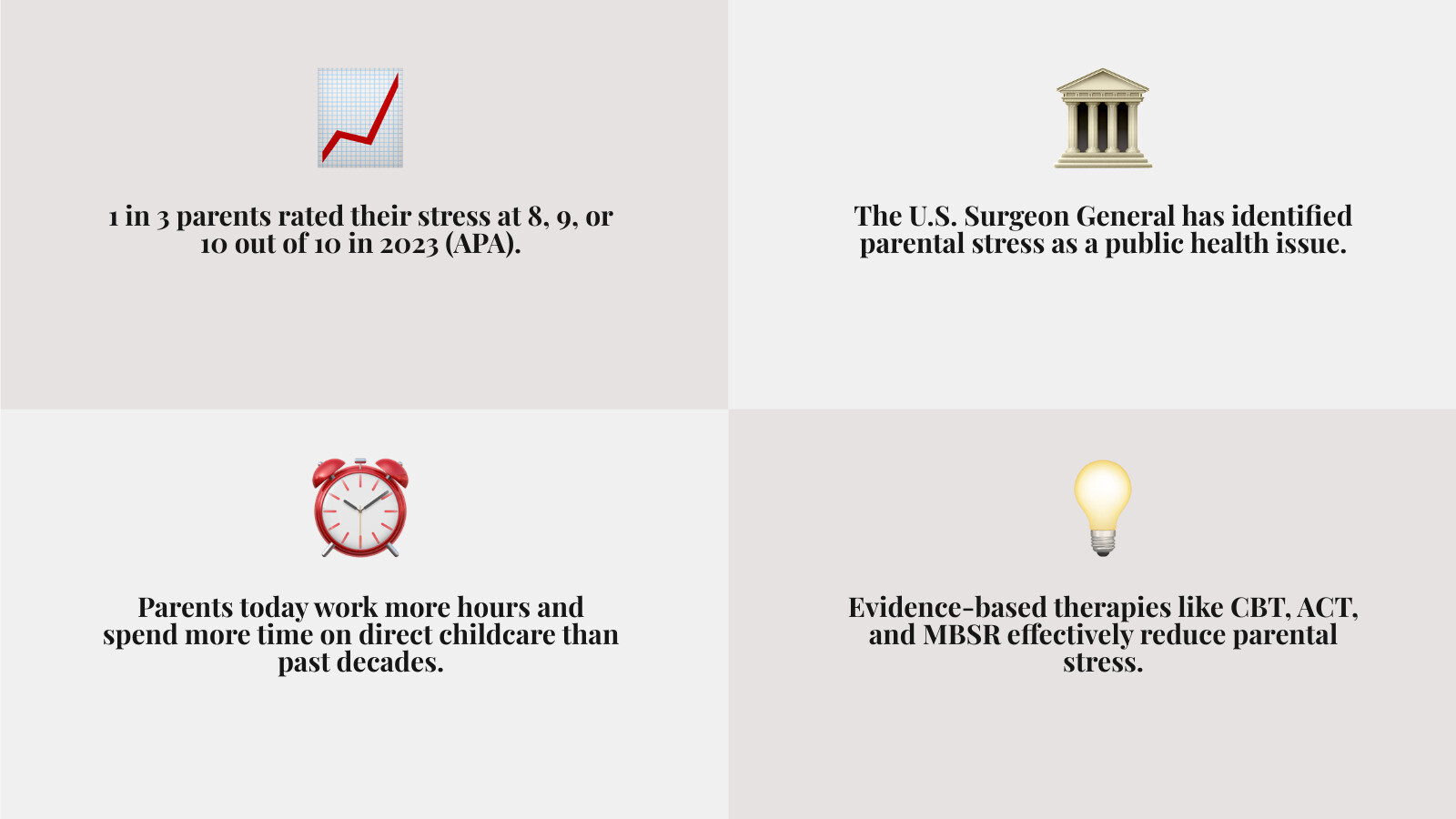
Parenting is one of the most demanding jobs a person can have, and the pressure is measurably growing. According to the American Psychological Association, one in three parents rated their stress at 8, 9, or 10 out of 10 in recent surveys. Nearly half of all parents say their stress feels completely overwhelming on most days.
The U.S. Surgeon General has formally identified parental stress as a public health issue. Parents today are working more hours than in past decades, while also spending significantly more time on direct childcare. At the same time, financial pressures, children’s mental health challenges, and the constant demands of technology have added new layers of strain.
This is not a personal failure. It is a structural problem that affects millions of families.
The good news is that effective, evidence based therapy options exist. Whether you are dealing with daily overwhelm, creeping burnout, or a more serious mental health concern, professional support can make a real difference for you and your children.
Parental stress therapy help terms to learn:
Understanding Parenting Stress and Burnout
To address the challenges of modern caregiving, we must first understand what parenting stress actually is. At its core, stress occurs when your current resources, such as your energy, social support, or time, are simply not enough to meet the immediate demands placed upon you. When you parent, these demands are constant. They do not pause for vacations, sick days, or work deadlines.
While some amount of stress is a normal part of raising children, chronic exposure to these pressures can lead to a state of complete depletion. This state is known as parental burnout. It is an intense, long term condition that leaves parents feeling entirely drained of physical and emotional energy. Up to five million parents in the United States experience this level of burnout every single year.
When you are chronically stressed, the atmosphere of your entire home changes. Fortunately, learning to manage this pressure is not just about feeling better in the moment. It is also an active parenting strategy. When you learn to regulate your emotions, you model healthy coping mechanisms for your children. You can find practical ways to lower the temperature in your home by reading about tips for a calmer household.
The Difference Between Daily Stress and Burnout
It is common to confuse daily parenting stress with true parental burnout, but they are quite different. Daily stress is temporary. It might look like a chaotic morning when everyone is running late, or a rainy afternoon spent dealing with a toddler tantrum. Once the immediate situation is resolved or you get a good night of sleep, your energy returns.
Parental burnout is a chronic, systemic resource deficit. Sleep does not fix it. A brief weekend break does not cure it. It is characterized by three main symptoms:
- Emotional Exhaustion: Feeling completely empty, tired, and unable to face another day of parenting responsibilities.
- Depersonalization: Feeling emotionally detached from your children, as if you are going through the motions of caregiving without any real warmth or connection.
- A Decrease in Self Fulfillment: Feeling like you are failing as a parent, losing your sense of identity, and experiencing a total loss of joy in your parenting role.
A particularly telling sign of burnout is escape ideation. This is when a parent frequently fantasizes about walking away from their family or disappearing just to get a break from the constant pressure.
| Feature | Daily Parenting Stress | Parental Burnout |
|---|---|---|
| Duration | Temporary and situational | Chronic and ongoing |
| Recovery | Resolved with rest or a short break | Does not improve with standard rest |
| Connection | Parent remains emotionally engaged | Parent feels detached or numb |
| Self Image | Parent feels tired but capable | Parent feels like a total failure |
| Fantasies | Wishing for a quiet evening | Wishing to escape responsibilities entirely |
Common Causes and Symptoms of Caregiver Anxiety
Caregiver anxiety is often driven by a mix of internal expectations and external pressures. Today, societal expectations around parenting are incredibly high. The rise of social media has created an environment where parents constantly compare themselves to idealized, curated versions of family life. This fosters the belief that you must be a perfect parent who manages nutrition, academic success, extracurricular activities, and emotional development flawlessly.
According to research from the American Psychological Association, these high expectations can lead to severe mental health struggles. You can read more about what psychologists suggest for managing these intense pressures in this guide on how parents can manage stress and burnout.
The symptoms of caregiver anxiety are both psychological and physical. Common signs include:
- Constant Worry: A mind that never stops running, constantly anticipating potential problems or feeling guilty about unfinished tasks.
- Physical Tension: Muscle tightness, frequent headaches, or a clenched jaw.
- Sleep Disturbances: Difficulty falling asleep or staying asleep, even when your children are resting quietly.
- Irritability: Snapping at your children or partner over minor issues because your emotional bandwidth is entirely used up.
- Hyper Vigilance: Feeling constantly on edge, waiting for the next behavioral meltdown, injury, or schedule conflict.
How Chronic Stress Affects Parents and Children

Chronic stress does not exist in a vacuum. Because families function as interconnected systems, the emotional state of a parent directly shapes the emotional environment of the home. When a parent is constantly anxious, overwhelmed, or depressed, children pick up on those cues. This phenomenon is known as emotional contagion.
When parents are chronically stressed, they have less patience and are more likely to respond to child misbehavior with anger or withdrawal. Over time, this can disrupt the parent child bond and make children feel insecure. If you find that stress is causing frequent conflicts or emotional distance in your home, you can explore how professional guidance can help by reading about family therapy benefits.
The Bidirectional Impact on Family Dynamics
The relationship between parental stress and child behavior is bidirectional and transactional. This means that your stress affects your child’s behavior, and your child’s behavior in turn affects your stress levels. It becomes a self reinforcing cycle.
For example, when a parent is exhausted and overwhelmed, they may struggle to set consistent boundaries. The child, sensing the inconsistency or emotional absence, may act out or exhibit difficult behaviors to get attention or test limits. This increase in challenging behavior then spikes the parent’s anxiety and exhaustion, making the household feel increasingly chaotic.
Breaking this cycle requires intervention. By addressing the parent’s stress first, the parent can regain the emotional regulation needed to respond to the child with calm, consistent, and loving guidance.
Unique Challenges for Parents of Children with Special Needs
Parents of children with special educational needs, such as autism spectrum disorder or physical disabilities, face a unique and highly demanding set of stressors. These caregivers often spend dozens of hours each week managing therapy appointments, navigating school accommodations, and providing specialized daily care. This level of responsibility is equivalent to a full time job on top of their standard daily routines.
The mental health impact on these families is significant:
- Approximately 31% of parents of autistic children meet the criteria for major depressive disorder.
- About 33% of these parents experience a clinical anxiety disorder.
- Mothers of autistic children are nearly three times more likely to experience depression compared to parents of typically developing children, while fathers are more than twice as likely.
Traditional parenting strategies and standard advice often fall short for these families. To learn more about how specialized therapies can help, you can explore this scientific research on Acceptance and Commitment Therapy.
Additionally, structured programs designed to build parental self efficacy have shown great promise. You can read about the positive impact of these programs in this study on coping and parental competence interventions, or learn about creative counseling approaches in this integrative counseling program for distressed parents.
Evidence Based Therapeutic Approaches for Caregivers

When everyday coping mechanisms are not enough, professional, evidence based therapy can provide the tools you need to regain your balance. Therapy is not a luxury, nor is it a sign of weakness. It is a practical, structured way to build resilience, improve your mental health, and strengthen your family.
Different therapeutic modalities target different aspects of the stress response. Some focus on changing your internal thoughts, while others emphasize accepting unchangeable realities or practicing mindfulness. To understand how structured stress management programs work in a clinical setting, you can review this study on cognitive behavioral stress management.
Cognitive Behavioral Therapy and Stress Management
Cognitive Behavioral Therapy (CBT) is one of the most widely researched and effective treatments for stress and anxiety. CBT operates on the principle that your thoughts, feelings, and behaviors are closely connected. When you are highly stressed, you are more likely to experience cognitive distortions, which are biased, unhelpful ways of thinking.
Common cognitive distortions for parents include:
- All or Nothing Thinking: Believing that if you are not a perfect parent, you are a complete failure.
- Catastrophizing: Assuming the worst possible outcome will happen, such as believing a bad grade in elementary school means your child will never succeed in life.
- Should Statements: Pressuring yourself with rigid rules about what you should or must be doing at all times.
A CBT therapist helps you identify these unhelpful thought patterns and replace them with more balanced, realistic perspectives. CBT also incorporates problem solving therapy to help you break down overwhelming challenges into manageable steps, as well as behavioral activation to help you schedule small, rewarding activities back into your life.
If you want to explore how these techniques are applied, you can learn more about our approach to therapy for stress and explore specific options for stress management therapy. You can also read about 5 effective strategies for stress management to start making small changes today.
Acceptance and Commitment Therapy for Psychological Flexibility
While CBT focuses on changing unhelpful thoughts, Acceptance and Commitment Therapy (ACT) takes a different approach. ACT is particularly useful for parents who face chronic, unchangeable stressors, such as raising a child with a chronic illness or special needs.
In some cases, trying to constantly restructure your thoughts can feel like an exhausting chore. ACT teaches you to accept your difficult thoughts and feelings rather than fighting them. It helps you build psychological flexibility, which is the ability to stay present in the moment and act in alignment with your deepest values, even when things are incredibly hard.
Core components of ACT include:
- Cognitive Defusion: Learning to see your thoughts as merely words passing through your mind, rather than absolute truths that dictate your emotions.
- Acceptance: Making room for difficult emotions, like frustration or grief, without judging yourself for having them.
- Value Guided Actions: Identifying what truly matters to you as a parent, such as kindness, connection, or humor, and committing to small actions that reflect those values every day.
Mindfulness Based Stress Reduction and Digital Interventions
Mindfulness Based Stress Reduction (MBSR) is another powerful tool for overwhelmed parents. MBSR teaches you to pay attention to the present moment without judgment. This practice creates a vital pause between a stressful event, like a child spilling milk or refusing to put on shoes, and your emotional response.
Instead of reacting with immediate frustration, mindfulness allows you to take a deep breath and respond with intention. Because busy parents often struggle to find time for traditional, weekly in person classes, digital and online delivered mindfulness programs have become increasingly popular.
Research has shown that even brief, online delivered mindfulness courses can significantly reduce parental stress and improve well being. You can read about how these digital programs perform in this research on online mindfulness programs.
Furthermore, digital interventions can make therapy highly accessible. While some complex, self guided apps may not always outperform basic education, having access to structured support on your smartphone is a valuable resource. You can explore the data on mobile mental health tools in this study on smartphone based interventions for parenting stress.
When to Seek Professional Parental Stress Therapy Help
It can be difficult to know when normal parenting fatigue has crossed the line into something that requires professional parental stress therapy help. Many parents wait until they are in a state of complete crisis before reaching out, but seeking help early can prevent chronic burnout and protect your family’s well being.
You should consider reaching out to a professional if you experience any of the following:
- Your stress or anxiety interferes with your ability to perform daily tasks, care for your children, or manage your job.
- You feel constantly irritable, angry, or find yourself frequently yelling at your loved ones.
- You experience persistent feelings of hopelessness, emptiness, or a total loss of interest in activities you once enjoyed.
- You find yourself withdrawing from your partner, friends, or family members.
- You are experiencing physical symptoms of stress, such as chronic insomnia, frequent headaches, or stomach issues, that have no clear medical cause.
If you are wondering whether your current struggles warrant professional support, you can read about the 10 signs it might be time to see a therapist.
How to Access Parental Stress Therapy Help Online
One of the biggest barriers to mental health support for parents is time. Between school runs, work, meal preparation, and bedtime routines, finding a spare two hours to travel to and from a therapy office can feel impossible.
This is where teletherapy and online counseling are incredibly beneficial. Online therapy allows you to meet with a licensed, professional therapist from the comfort of your home, office, or even your parked car. It offers:
- Scheduling Flexibility: You can easily fit sessions into lunch breaks, early mornings, or nap times.
- Comfort and Privacy: You can speak openly in an environment where you feel safe and relaxed.
- No Commute: You save valuable time and eliminate the need to arrange childcare just to attend an appointment.
By removing these logistical hurdles, online therapy makes it much easier to stay consistent with your mental health care. You can also support your therapy journey by learning how to build a daily routine that reduces stress.
Finding the Right Parental Stress Therapy Help for Your Family
Finding a therapist who understands the unique pressures of modern parenting is essential. You want to work with a licensed professional who has specific experience in family systems, stress management, caregiver burnout, or child development.
At Collective Counseling Solutions, we simplify this process by connecting you with skilled, licensed therapists who accept your insurance. We offer both in person and teletherapy options, allowing you to choose the format that best fits your family’s busy lifestyle.
When choosing a therapist, consider their clinical specialties and therapeutic approach. You can read our practical guide on how to choose a good therapist for you or learn more about the matching process by reading how do I find a therapist who is right for me.
Additionally, if your relationship with your partner is feeling the strain of parenting, you might want to look into how joint sessions can help by reading about why family and couples stress management counseling is a game changer.
Frequently Asked Questions about Parenting Stress
What is the difference between parenting stress and clinical anxiety
Parenting stress is directly tied to the challenges of raising children and typically fluctuates based on your immediate circumstances. Clinical anxiety, on the other hand, is a more persistent condition characterized by excessive, uncontrollable worry that often extends beyond parenting into other areas of life.
While parenting stress might make you feel overwhelmed by a busy schedule, clinical anxiety can cause constant worry, physical symptoms like a racing heart, and difficulty functioning even when things are going smoothly. If you suspect you are dealing with clinical anxiety, professional support can help. You can learn more about our approach to therapy for anxiety.
Can therapy help parents who are managing depression
Yes, therapy is highly effective for parents managing depression. Parental depression can make the physical and emotional demands of caregiving feel completely insurmountable. It can also cause parents to feel disconnected from their children, which can trigger intense feelings of guilt.
A therapist can help you develop healthy coping mechanisms, practice self care without guilt, and learn emotional regulation strategies. This not only supports your own healing but also protects your children from the emotional impact of parental depression. You can explore your treatment options by reading about our therapy for depression, or learn more about how depression specifically interacts with caregiving in this resource on parenting stress and mental health.
How does parental burnout affect child behavior
Because of emotional contagion, children are highly sensitive to their parents’ emotional states. When a parent is experiencing burnout, they may struggle to remain emotionally present, patient, and consistent with house rules.
Children may respond to this emotional distance by acting out, showing signs of anxiety, or struggling with their own emotional regulation. By seeking help for parental burnout, you are not just caring for yourself, you are actively improving your child’s emotional environment and helping them feel safe, secure, and supported.
Conclusion
Parenting is a beautiful, rewarding journey, but it is also one of the most challenging roles you will ever have. If you are feeling overwhelmed, exhausted, or disconnected, please remember that you do not have to carry this heavy load all by yourself. Seeking parental stress therapy help is a courageous step that benefits your entire household.
At Collective Counseling Solutions, we believe that accessing high quality mental health care should be simple and stress free. We connect you with compassionate, licensed therapists who accept your insurance and offer flexible teletherapy and in person sessions designed to fit your busy life.
You do not have to wait for a total crisis to start feeling better. Take the first step toward a calmer, more balanced family life today. You can easily find a therapist through our network or contact us directly to learn more about how we can support you.