

When Relationship Stress Feels Like Too Much to Handle Alone
Couples stress management counseling is a specialized form of therapy that helps partners identify stress triggers, improve communication, and build resilience together before small tensions turn into serious damage.
Quick answer: What does couples stress management counseling involve?
- Identifying stress sources — work, finances, parenting, life transitions
- Learning communication tools — like “I” statements and active listening
- Breaking negative cycles — such as criticism, withdrawal, and resentment
- Building shared coping strategies — mindfulness, rituals of connection, boundary-setting
- Professional guidance — from a licensed therapist using evidence-based methods like the Gottman Method or EFT
Relationships are one of our greatest sources of emotional support. But they’re also one of the first things to suffer when life gets hard.
Work pressure. Financial strain. Exhaustion. When stress piles up, it doesn’t stay contained. It spills into how we talk to each other or stop talking to each other.
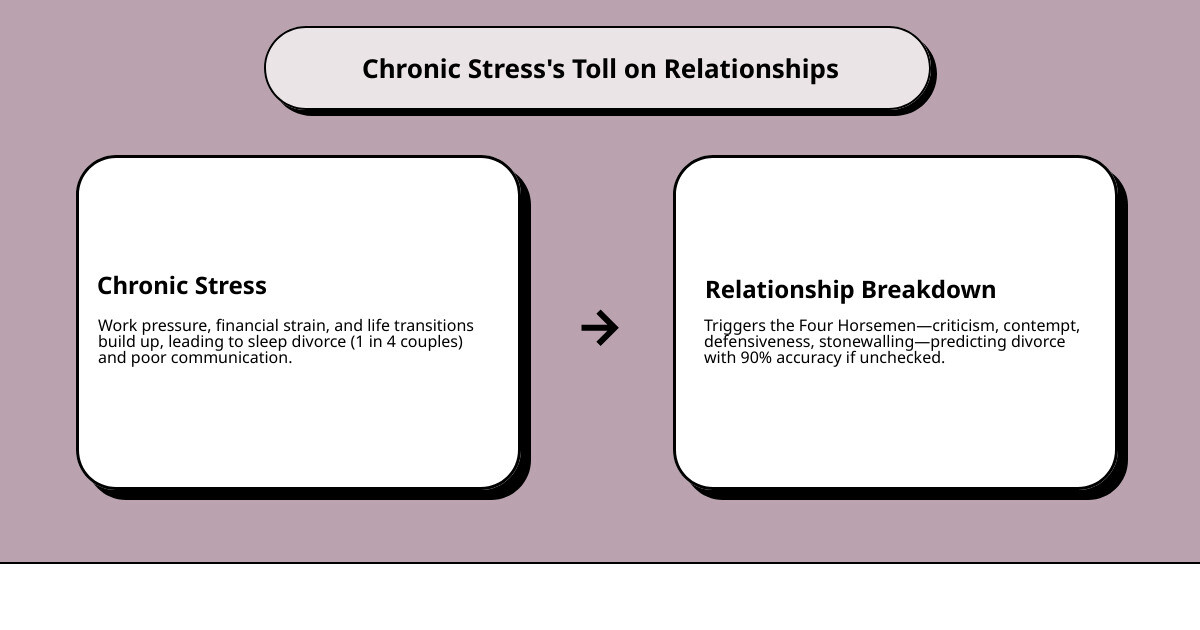
Research shows that one in four couples no longer sleep in the same bed due to stress in modern life. And the four most common stress-driven communication patterns are criticism, contempt, defensiveness, and stonewalling. These predict divorce with over 90% accuracy if left unchecked.
The good news? Most couples don’t have to get there.
Studies show that 70–80% of couples experience meaningful recovery after evidence-based therapy. Yet the average couple waits six years before seeking help. That’s six years of stress quietly eroding trust, intimacy, and connection.
Whether you’re feeling like roommates, stuck in the same argument on repeat, or simply stretched too thin to feel close, you’re not alone, and it’s not too late.
5 Signs Your Relationship Needs couples stress management counseling
It is 2026, and the pace of modern life has never been faster. Between the “always-on” nature of digital work and the rising cost of living, it is easy for couples to feel like they are drowning. But how do you know if your relationship is just going through a “rough patch” or if it’s time to call in the pros?

If you’re wondering, Do we need couples therapy?, look for these five red flags that indicate stress has moved from “manageable” to “destructive”:
- The Arrival of the “Four Horsemen”: Research by the Gottman Institute identifies four communication patterns that spell disaster: Criticism (attacking your partner’s character), Contempt (mocking or acting superior), Defensiveness (playing the victim), and Stonewalling (shutting down and withdrawing). If these are your primary ways of interacting, the foundation is at risk.
- “Roommate Syndrome”: This occurs when you feel like co-managers of a household rather than romantic partners. You talk about the mortgage, the kids, and the grocery list, but you haven’t had a heart-to-heart or a laugh in months.
- Technoference: This is the phenomenon where technology interferes with your relationship. If every dinner or “quality time” moment is interrupted by a smartphone, it creates a sense of emotional neglect. It takes roughly 60 seconds to refocus on a conversation after checking a phone; most couples don’t realize they’re losing.
- The “Sleep Divorce”: While some couples sleep apart for snoring reasons, many do it to avoid the tension or because they are on different schedules due to work-related stress. If you are sleeping in separate rooms because you can’t stand the proximity, it’s a sign of deep-seated irritability.
- Emotional Withdrawal: Instead of fighting, you simply stop sharing. You no longer tell your partner about your bad day at work because it feels like too much effort, or you fear their reaction.
Recognizing these signs early is key. Couples stress management counseling isn’t just for couples on the brink of divorce; it’s for any pair that wants to stop the “slow drift” apart.
Evidence-Based Techniques for Navigating Life Transitions
Life doesn’t stand still. Major transitions like becoming parents, changing careers, or dealing with an empty nest are high-stress periods that can expose hidden gaps in communication. During these times, the nervous system often stays in a “fight or flight” mode, making every small disagreement feel like a personal attack.

In couples stress management counseling, therapists use specific, research-backed frameworks to help you regulate your nervous system and find your way back to each other. Understanding what happens in couples therapy can demystify the process.
| Feature | Gottman Method | Emotionally Focused Therapy (EFT) |
|---|---|---|
| Primary Focus | Skill-building and conflict management | Attachment bonds and emotional safety |
| Key Tool | The Sound Relationship House | De-escalating negative cycles |
| Goal | Improve friendship and shared meaning | Create secure emotional connection |
| Success Rate | High (90% report improvement) | 70-75% recovery from distress |
The Role of the Gottman Method in couples stress management counseling
The Gottman Method is widely considered the gold standard in relationship science. It is built on the “Sound Relationship House” theory, which emphasizes building “Love Maps”, a deep understanding of your partner’s inner world, including their stresses, hopes, and fears.
A major focus in this method is recognizing “bids for connection.” A bid can be as simple as your partner pointing out a bird outside or asking a question. Turning toward these bids, rather than away, builds a “bank account” of goodwill that helps you survive stressful times. When you know the right questions to ask in couples therapy, you can start rebuilding that friendship.
How EFT and IBCT Improve Couples Stress Management Counseling
While Gottman focuses on skills, Emotionally Focused Therapy (EFT) focuses on the “why” behind the fight. It looks at the attachment bonds between partners. If one partner feels “unseen,” they might lash out or withdraw. EFT helps couples identify these cycles and create a “safe base.”
Integrative Behavioral Couple Therapy (IBCT) uses the “DEEP” framework to analyze distress:
- Differences in personality.
- Emotions that are triggered.
- External stressors (work, money, health).
- Patterns of communication.
IBCT is unique because it balances the need for change with the need for acceptance. Sometimes, the goal isn’t to fix the stressor, but to change how you respond to it as a team. This is one of the most effective strategies for stress management for long-term partners.
Practical Self-Help Strategies to Manage Stress as a Team
You don’t have to wait for your next session to start making changes. Managing stress together requires a mix of individual responsibility and collective effort.
Here are several 7 steps to manage stress that you can implement tonight:
- Master the “I” Statement: Instead of saying, “You never help with the dishes,” try, “I feel overwhelmed when the kitchen is messy, and I would appreciate some help.” This prevents the “defensiveness” horseman from entering the room.
- Practice Active Listening: Put the phone away. Make eye contact. Repeat back what you heard: “So what I’m hearing is that you felt unsupported at the party today. Is that right?”
- Create Rituals of Connection: This could be a 10-minute coffee together in the morning or a “no-phones” walk after dinner. These small moments act as a buffer against external stress.
- Individual Self-Care: You cannot be a good partner if you are running on empty. Prioritize your own sleep, exercise, and hobbies. As we often say in therapy for stress, you have to put on your own oxygen mask first.
- Practice Gratitude: Note one thing you appreciate about your partner every day. It’s hard to stay resentful when you are actively looking for the good in someone.
- Set Digital Boundaries: Establish “tech-free zones” in the house, especially the bedroom, to combat technoference and improve intimacy.
Common Questions About Relationship Stress Support
Seeking help is a sign of strength, but it’s natural to have questions before you dive in.
How effective is professional counseling for reducing relationship stress?
Professional couples stress management counseling is incredibly effective. Statistics show that 70-80% of couples show meaningful recovery when using evidence-based models. Furthermore, 90% of couples report significant improvements in their emotional well-being. By understanding what do couples do in therapy, you can see that it isn’t just “venting”—it’s a structured process of rebuilding resilience.
What should we expect during our first stress management session?
Your first session is usually an intake process. The therapist will act as a neutral third party to assess the relationship’s strengths and challenges. You’ll discuss your history, your current stressors, and your goals. This is also the time to discuss couples therapy and insurance to ensure your care is accessible and sustainable. The goal is to build a “therapeutic alliance” where both partners feel heard and neither feels “ganged up on.”
Are online and telehealth options effective for couples?
Absolutely. In 2026, online couples therapy is more popular than ever. Research shows that teletherapy is just as effective as in-person sessions for improving relationship satisfaction and resolving conflict. It offers unparalleled convenience, no need to find a babysitter or fight traffic, and allows you to engage in therapy from the comfort of your own “sanctuary.”
Conclusion: Taking the First Step Toward Healing
Stress is an inevitable part of life, but it doesn’t have to be the end of your relationship. Whether you are dealing with the pressures of a new baby, financial uncertainty, or the simple wear-and-tear of modern life, couples stress management counseling provides the roadmap to navigate these challenges together.
At Collective Counseling Solutions, we specialize in connecting you with licensed, insurance-accepting therapists who understand the complexities of modern love. You don’t have to wait until your relationship is in crisis to start building a stronger bond.
If you are ready to move from “survival mode” back into a thriving partnership, contact us to schedule a consultation.
Note: If your relationship involves physical safety concerns or abuse, please reach out for immediate help. You can contact the National Domestic Violence Hotline at 1-800-799-SAFE (7233) or text “START” to 88788.