
Why Nervousness Happens — And What You Can Do Right Now
Coping with nervousness starts with understanding what your body is actually doing and knowing you have real tools to calm it down fast.
Here are the most effective ways to manage nervousness quickly:
- Take slow, deep breaths — exhale longer than you inhale to activate your body’s calm response
- Use the 5-4-3-2-1 method — name 5 things you see, 4 you can touch, 3 you hear, 2 you smell, 1 you taste
- Try the 3-3-3 rule — name 3 things you see, 3 you hear, move 3 body parts
- Reframe the feeling — tell yourself “I am excited” to shift nervous energy into focus
- Move your body — even a short walk releases tension and burns off adrenaline
Everyone feels nervous sometimes. Before a job interview, a big presentation, or a difficult conversation. It’s that familiar rush of tension, racing heart, and sweaty palms that shows up uninvited.
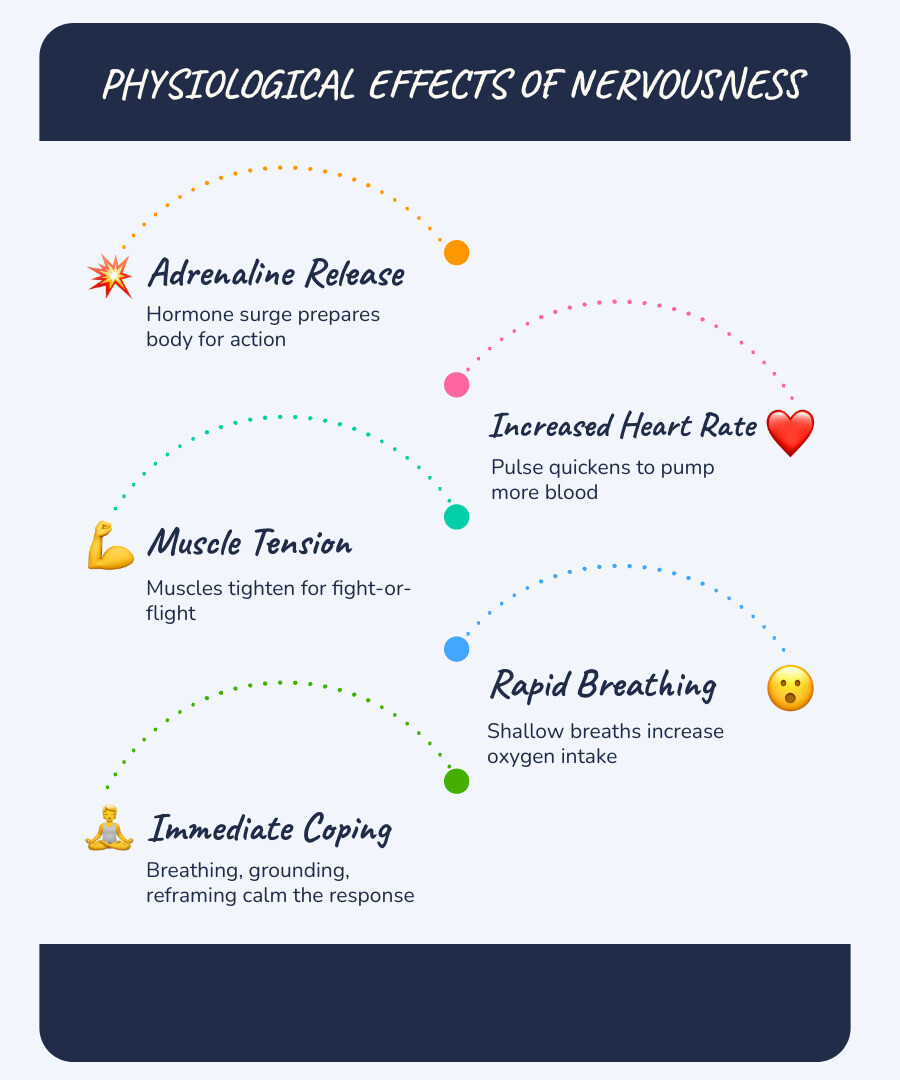
That’s your body’s fight-or-flight response kicking in. Your brain detects a challenge and floods your system with adrenaline and cortisol to prepare you for action. It’s the same survival mechanism humans have relied on for thousands of years.
The problem? Most of our “threats” aren’t physical dangers. They’re performance reviews, Zoom calls, and first dates. Your body reacts the same way regardless, and that response can feel overwhelming.
The good news: nervousness is temporary, manageable, and in many cases, a sign that something genuinely matters to you.
This guide gives you a practical, science-backed toolkit to calm your nerves right now, and over the long term.
Understanding the Difference: Nervousness vs. Anxiety Disorders
When you are standing in the wings of a stage or waiting for your name to be called in a lobby, the physical sensations can be intense. However, there is a distinct line between situational nervousness and a clinical anxiety disorder.
Nervousness is typically tied to a specific situational trigger. Once the event, whether it is a speech, a date, or a test, is over, the feelings dissipate. It is a temporary state of high arousal that you can usually manage with the right tools. Most importantly, it doesn’t stop you from living your life; you might do the “scary thing” while feeling shaky, but you still do it.
Anxiety disorders, on the other hand, are often more persistent and less predictable. They can involve a constant state of dread that exists even when there is no obvious “threat” on the horizon. If you find that your feelings are uncontrollable, long-lasting, and begin to interfere with your ability to work, socialize, or sleep, it may be more than just “nerves.”
| Feature | Situational Nervousness | Clinical Anxiety |
|---|---|---|
| Trigger | Clear, identifiable event (e.g., public speaking) | May occur without an obvious cause |
| Duration | Ends once the event is over | Persistent, lasting weeks or months |
| Intensity | Manageable jitters | Can feel overwhelming or paralyzing |
| Physical Signs | Sweaty palms, butterflies | Chronic fatigue, digestive issues, muscle aches |
If you find yourself wondering, “How do you know if you are struggling with anxiety?” it is worth looking at how often these feelings occur. Understanding what you need to know about anxiety disorders can help you decide if your current experience is a normal reaction to stress or something that requires professional support.
Immediate Techniques for Coping with Nervousness
When you are in the middle of a nervous “spike,” your brain’s logic centers have essentially been hijacked by your amygdala, which is the part of the brain responsible for survival. To get back into the driver’s seat, you need to ground yourself in the physical world.

One of the most effective tools for coping with nervousness is sensory engagement. By forcing your brain to process external data, you interrupt the internal loop of racing thoughts.
The 5-4-3-2-1 method is a gold standard in grounding. To do it, stop and acknowledge:
- 5 things you see: A pen, a spot on the ceiling, a tree outside.
- 4 things you can touch: Your hair, the fabric of your chair, the cool surface of a desk.
- 3 things you hear: The hum of the AC, a bird chirping, your own breathing.
- 2 things you can smell: Your coffee, the scent of the room, or even your own soap.
- 1 thing you can taste: A mint, a piece of gum, or the lingering taste of your last meal.
Another quick tool is the 3-3-3 rule. This is a simplified version where you name three things you see, three things you hear, and move three parts of your body (like rotating your ankles, wiggling your fingers, and shrugging your shoulders). Learning what is the 3-3-3 rule for anxiety can provide a go-to mental script when you feel a panic rising. If you need to know how to calm anxiety fast, these grounding methods are your first line of defense.
Breathing Exercises for Instant Calm
Your breath is the only part of your autonomic nervous system that you can consciously control. By changing how you breathe, you send a direct signal to your brain to “stand down.”
- Box Breathing: Used by high-performance athletes and Navy SEALs, this involves inhaling for 4 seconds, holding for 4, exhaling for 4, and holding for 4. It stabilizes the nervous system by regulating CO2 levels.
- The 4-7-8 Method: Inhale through your nose for 4 seconds, hold for 7, and exhale forcefully through your mouth for 8. The long exhale is the key; it stimulates the vagus nerve, which triggers the “rest and digest” response.
- Cyclic Sighing: A 2023 study found that this specific technique is incredibly effective for mood improvement. It involves two inhales through the nose (one full breath followed by a short “top-off” inhale) and one long, slow exhale through the mouth.
Scientific research on breathing techniques confirms that these physical interventions can lower your heart rate and cortisol levels in under two minutes.
Grounding Methods for Coping with nervousness
Beyond breathing, other physical “hacks” can help for coping with nervousness.
- Hand on Heart: Simply placing your hand over your heart and feeling the warmth and rhythm can release oxytocin, the “cuddle hormone,” which counters the effects of cortisol.
- Focus Distraction: Study a nearby object with intense curiosity. Look at the pattern of the wood grain on a table or the specific shade of blue in a coworker’s tie. This redirects your brain’s processing power away from the “threat.”
- Affect Labeling: This is the practice of naming your emotion. Instead of just feeling the panic, say to yourself, “I am feeling nervous right now.” Research shows that labeling an emotion reduces the activity in the amygdala.
For more immediate tools, check out these 7 anxiety hacks for immediate relief.
Preparation and Mindset Shifts for Stressful Events
Sometimes, the best way to handle nerves is to change how you perceive them. This is known as anxiety reappraisal.
Physiologically, nervousness and excitement are nearly identical: both involve a racing heart, butterflies, and a surge of energy. The difference is the story you tell yourself. Instead of saying “I am so nervous,” try saying out loud, “I am excited.” This shifts your mindset from a state of “threat” to a state of “opportunity.” It tells your brain that the adrenaline is “fuel” for your performance rather than a sign of impending failure.

Visualization is another powerful tool. Professional athletes spend hours visualizing every second of a game. You can do the same. Close your eyes and imagine the event going well. See yourself speaking clearly, answering questions with ease, and walking out of the room feeling proud. Use all five senses in your visualization to make it feel real to your brain.
Positive self-talk and perspective shifting also help. Ask yourself: “Will this matter in five years? Five months? Even five days?” Often, we suffer from the “spotlight effect,” believing everyone is hyper-focused on our mistakes, when in reality, they are usually preoccupied with their own nerves.
Strategies for Coping with nervousness in Public Speaking
Public speaking is one of the most common triggers for intense nervousness. To manage it on the spot:
- Speak “Low and Slow”: Adrenaline tends to make our voices higher and faster. Consciously lowering your pitch and slowing your pace prevents vocal cracks and gives your brain time to catch up with your mouth.
- Hydration: Nervousness often causes “dry mouth.” Keep a bottle of water handy. The act of sipping water also forces you to pause and breathe.
- Persuasion over Perfection: Don’t aim for a flawless delivery. Aim to connect with your audience. If you make a mistake, acknowledge it with a smile and move on. Authenticity is more engaging than a robotic, “perfect” performance.
Long-Term Strategies and Lifestyle Habits
While “in-the-moment” hacks are vital, coping with nervousness effectively requires a foundation of healthy habits. Think of it as lowering the “baseline” of your stress levels so that when a challenge arises, you aren’t already near your breaking point.
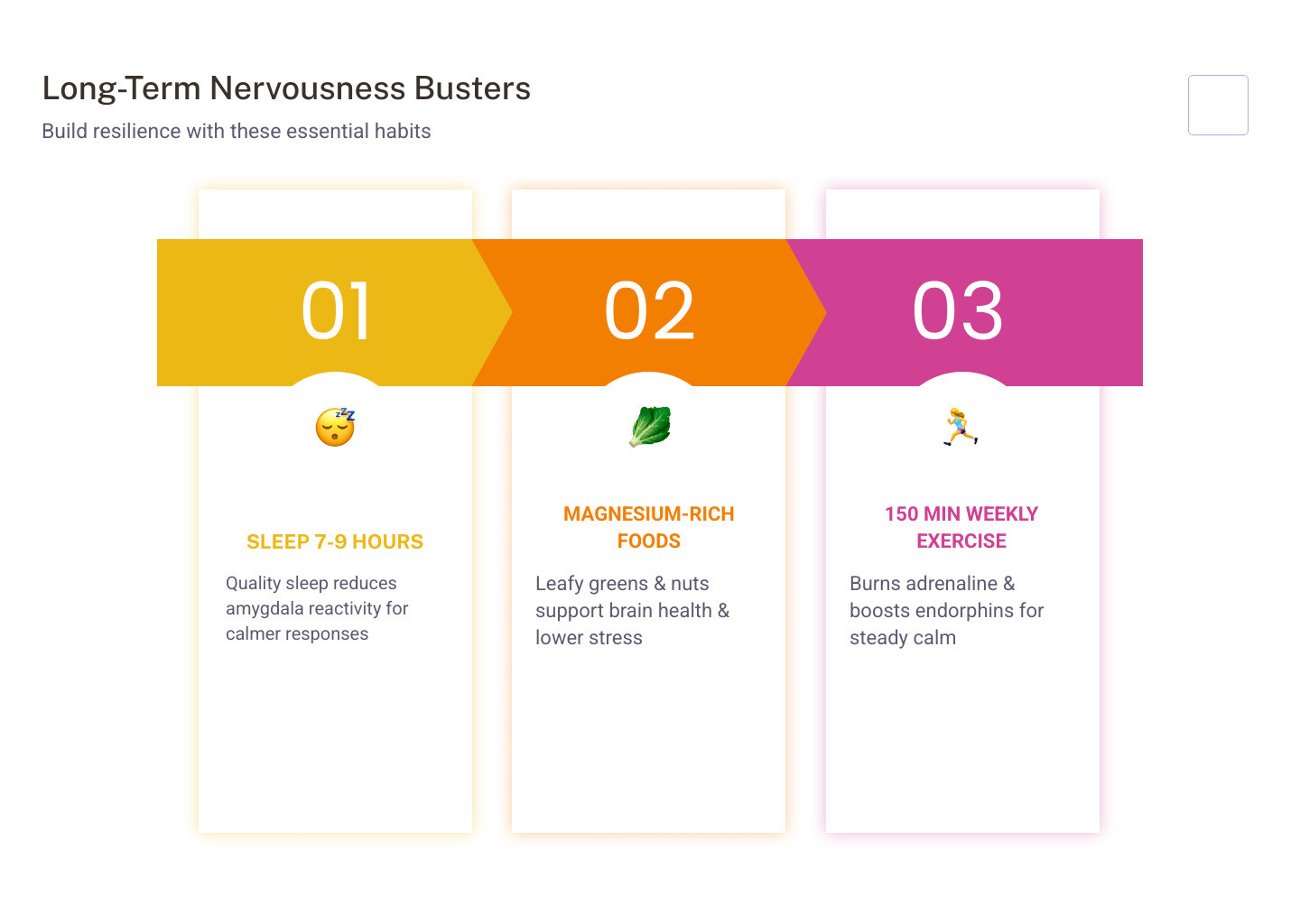
- Sleep Hygiene: Most adults need 7 to 9 hours of sleep. Insufficient sleep makes your amygdala more reactive, meaning you’ll feel more nervous about smaller things.
- Dietary Support: What you eat affects your nervous system. Magnesium-rich foods (like leafy greens and nuts), zinc (egg yolks, cashews), and Omega-3s (salmon) support brain health. Conversely, excessive caffeine and sugar can mimic or worsen the physical symptoms of nervousness.
- Physical Activity: Aim for at least 150 minutes of moderate exercise per week. Exercise releases endorphins and helps “burn off” the excess adrenaline that contributes to chronic jitters.
Establishing long-term ways to manage anxiety is about consistency. The CDC also provides excellent resources for managing stress through daily habits.
Cognitive Reframing and Relaxation
Cognitive Behavioral Therapy (CBT) tools are incredibly effective for the long-term management of nerves.
- Cognitive Reframing: This involves identifying unhelpful thoughts (e.g., “I’m going to fail and lose my job”) and challenging them with evidence. Is it true? Has it happened before? What is a more balanced thought?
- Progressive Muscle Relaxation (PMR): This involves tensing and then releasing each muscle group in your body, from your toes to your forehead. It teaches you to recognize the difference between tension and relaxation.
- Journaling: Writing down your thoughts “transfers” them from your head to the paper. It can help you identify patterns and triggers you might not have noticed otherwise.
- ABC Please: A dialectical behavior therapy (DBT) skill that stands for: Accumulate positive emotions, Build mastery, Cope ahead, and PLEASE (taking care of physical health).
If you find that self-help isn’t enough, therapy for anxiety can provide a structured environment to learn these skills.
When to Seek Professional Support
It is important to remember that you don’t have to navigate these feelings alone. While everyone gets nervous, you should consider seeking professional help if:
- The Symptoms are Persistent: You feel nervous most days for two weeks or more.
- You Experience Panic Attacks: Sudden, intense waves of fear that cause chest pain or shortness of breath.
- Avoidance: You have started avoiding social situations, work opportunities, or hobbies because of your nerves.
- Physical Toll: Your nervousness is causing chronic stomach issues, headaches, or insomnia.
Specialized therapy for anxiety and panic attacks can help you regain control. A therapist can help you identify anxiety triggers in therapy that you might be blind to on your own.
Frequently Asked Questions about Nervousness
Can nervousness cause chest pain?
Yes. When you are nervous, your muscles, including those in your chest, tighten. This tension can cause sharp or dull pains that mimic more serious conditions. Additionally, rapid breathing (hyperventilation) can cause a feeling of tightness or “air hunger.” However, if chest pain is accompanied by pain radiating down the arm, extreme nausea, or fainting, you should seek emergency medical attention immediately to rule out cardiac issues.
What is the difference between an anxiety attack and a panic attack?
While people often use the terms interchangeably, they are clinically different. An “anxiety attack” is not a formal medical diagnosis but usually refers to a period of intense worry that builds up over time. A panic attack is a sudden, intense surge of fear that peaks within minutes and often includes physical symptoms like a racing heart, shaking, and a “sense of doom.” Panic attacks can happen “out of the blue,” whereas anxiety is usually tied to a specific stressor.
How does stress differ from worry?
Stress is generally your body’s response to an external demand or “task” (like a deadline), often involving the feeling that you don’t have enough resources to handle it. Worry is a cognitive process. It is the “what if” thoughts that happen in your mind. While stress is a physiological and emotional reaction, worry is the mental attempt to solve problems or analyze risks.
Conclusion
Coping with nervousness is a skill that can be learned and refined over time. Whether you are using the 5-4-3-2-1 method before a big meeting or building a more resilient lifestyle through exercise and sleep, every small step counts.
If you find that nervousness is holding you back from the life you want to lead, Collective Counseling Solutions is here to help. They connect clients with licensed, skilled therapists who accept insurance, making the path to healing simpler and more accessible. Whether you prefer in-person sessions or the convenience of teletherapy, professional support can help you move from a state of “fighting” your nerves to a state of managing them with confidence.
Your journey toward a calmer, more focused version of yourself starts today. Find a therapist who can help you build your personalized toolkit for lasting relief.