

How Individual Marriage Counseling Can Help You Start Changing Your Relationship
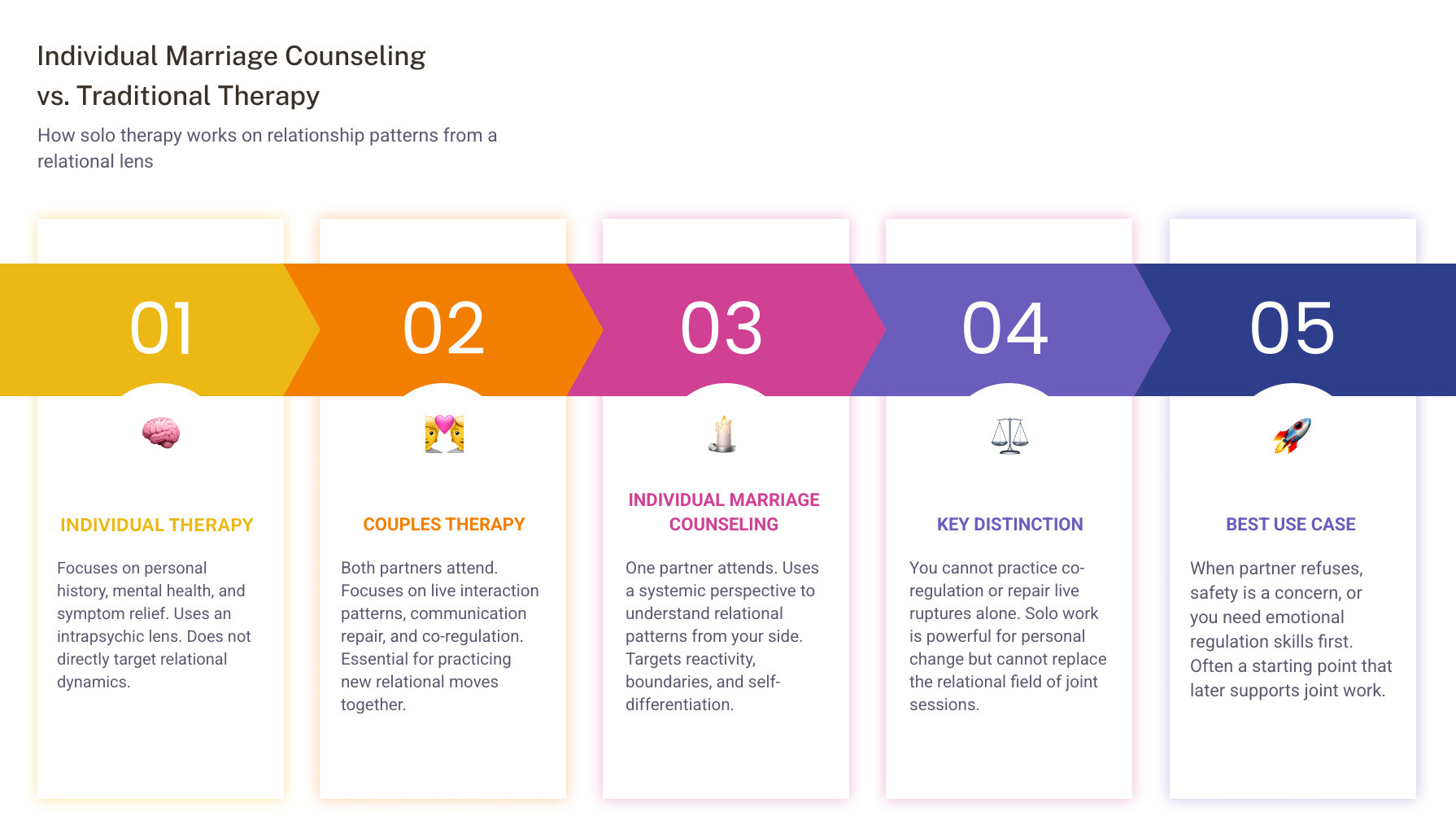
Individual marriage counseling helps you work on relationship patterns even when you attend therapy alone. Choose it when your partner will not join you, you need stronger boundaries or emotional regulation, or joint sessions do not feel safe yet. Look for a licensed therapist with training in marriage and family or couples work, not only general individual therapy.
Solo work can help you notice what happens before conflict, respond with less reactivity, and communicate your needs more clearly. But it cannot fully replace couples therapy when the main problem appears in live moments between both partners. Those moments often require both people present to practice new ways of calming, listening, and repairing.
The goal is not to decide who is right. It is to understand the pattern you are part of and change the steps you can control. For many people, individual work becomes a useful starting point that later supports joint sessions.
Simple guide to individual marriage counseling terms:
Understanding Individual Marriage Counseling vs Traditional Therapy
Understanding the distinct therapeutic models available helps individuals choose the right path for relational healing. While individual therapy may address personal emotions, behaviors, and relationship patterns, couples therapy focuses more directly on the interactions and challenges between partners. Solo relationship counseling occupies a unique middle ground. It maintains a systemic perspective while working directly with only one partner to resolve relational distress and shift persistent relationship patterns.
| Therapeutic Modality | Primary Focus | Who Attends | Core Objective |
|---|---|---|---|
| Traditional Individual Therapy | Intrapsychic healing, personal symptoms, individual history | One person | Enhance personal functioning, self awareness, and symptom reduction |
| Traditional Couples Therapy | Interpersonal dynamics, shared interactions, relational field | Both partners | Improve mutual communication, resolve conflict, and rebuild intimacy |
| Individual Marriage Counseling | The relationship dynamic viewed through one person’s lens | One person | Shift systemic loops, establish boundaries, and clarify marital goals |
How Solo Relational Therapy Differs From Standard Care
Standard solo therapy often concentrates on intrapsychic processes. A clinician might address personal mood difficulties, self worth, or historical family background. In that space, standard treatments like Therapy for Anxiety focus heavily on personal self regulation and individual thought patterns.
Solo relational counseling shifts the primary lens from intrapsychic exploration to interpersonal dynamics. Rather than focusing solely on individual concerns, the therapist explores how the client’s emotions, behaviors, and communication patterns shape their relationships. The therapist examines how one person’s actions, emotional regulation, and communication habits affect their broader relational ecosystem. The work targets personal accountability within the partnership, helping the attending individual understand how their emotional reactions and communication habits may influence interactions with their partner.
The Dry Land Swimming Problem: Relational Fields vs Solo Exploration
One challenge of individual relationship counseling can be compared to learning to swim on dry land. A person can study swimming techniques, practice breathing strokes on a living room floor, and master the theoretical mechanics of swimming. Yet, until they plunge into open water, they cannot truly test their buoyancy or manage the real shock of cold waves.
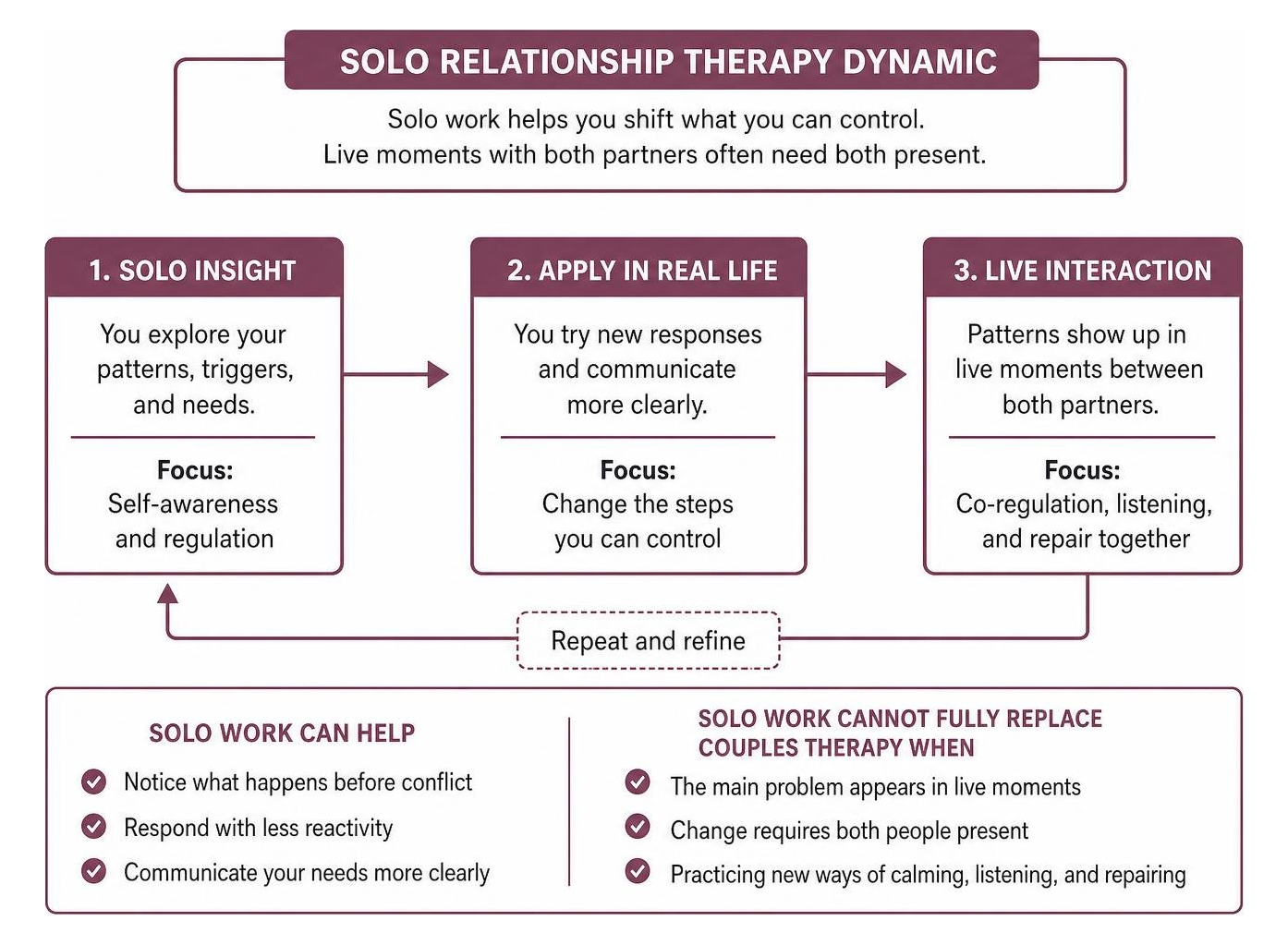
In relationships, the interactive field between two partners carries real-time neurological triggers. Partners can influence each other’s emotional responses during interactions, sometimes helping one another feel calmer or contributing to escalating tension. Solo exploration lets a client examine vulnerabilities in a calm, safe environment. However, when the live triggers of the recurring patterns of marital conflict ignite at home, solo insights can instantly evaporate under intense somatic responses. Recognizing this limitation is vital. Solo relationship counseling builds awareness, but resolving live interactive loops often requires testing those skills directly in the relational field.
When to Choose Individual Marriage Counseling Over Couples Sessions
While joint therapy remains the gold standard for shared marital repair, specific situations make individual marriage counseling the more effective or necessary choice. Deciding between individual and joint therapy often requires exploring resources like Do We Need Couples Therapy? How to Know When It’s Time to evaluate whether both partners are ready to engage productively.

Navigating Partner Resistance and Building Interior Sovereignty
When a spouse outright refuses joint therapy, the willing partner does not need to remain completely stuck. Individual relationship counseling can help a person change their own responses, establish healthier boundaries, and improve communication, even when their partner chooses not to participate. Through the process of self-differentiation, one partner learns to maintain their internal emotional balance without needing their spouse to react in a specific way.
When facing severe Couples Therapy Conflict, unhelpful reactivity can escalate arguments quickly. Solo counseling teaches a partner how to stop dancing their half of the destructive pattern. By mastering intentional boundary setting and refusing to engage in familiar defensive routines, an individual can interrupt entrenched loops and invite unexpected positive responses from their resistant partner.
When Active Safety and Acute Trauma Preclude Joint Sessions
Joint therapy requires a foundation of physical and emotional safety. Couples therapy may be unsafe or inappropriate when a relationship involves ongoing abuse, coercive control, intimidation, or a risk of retaliation. A qualified clinician should assess safety and determine whether individual support, specialized services, or another approach is most appropriate. In these moments, bringing both individuals into the same room can increase danger or lead to retaliation outside the counseling office.
Solo work provides crucial trauma stabilization and personal protection strategies. Furthermore, in cases of severe deceit or unaddressed Couples Therapy Infidelity, solo counseling allows the injured partner to process raw betrayal trauma privately. This enables them to clarify their personal values before deciding whether to enter joint repair work.
The Risks of Solo Work: Avoiding the Courtroom Alliance Trap
Solo relationship counseling carries distinct clinical hazards when handled without systemic care. The most significant hazard is the courtroom alliance trap.

When an individual attends therapy alone to discuss relationship struggles, they naturally present one sided narratives. If a clinician lacks systemic training, they might inadvertently validate every grievance without considering the broader interpersonal cycle. This dynamic turns the therapist into a supportive judge who confirms that the absent partner is entirely at fault.
Why Individual Marriage Counseling Requires Systemic Neutrality
To prevent toxic relationship polarization, a skilled practitioner maintains strict systemic neutrality and circular causality. The therapist explores patterns of interaction while recognizing that responsibility for harmful behavior is not always shared equally. In situations involving abuse or coercive control, safety and individual accountability must take priority.
Therapists actively challenge client confirmation bias and demand personal relational accountability. Rather than asking how a spouse caused an issue, the clinician asks how the client responded, what vulnerability motivated that reaction, and how that reaction impacted the partner. When seeking this specialized care, reviewing professional information about marriage and family therapists can help clients identify practitioners who understand systemic balance and avoid taking one sided stances.
Shifting the Relationship Dynamic as a Single Participant
Systems theory suggests that changes in one person’s behavior can influence broader relationship patterns, although the other partner’s response cannot be guaranteed. When an individual adopts constructive emotional leadership, they produce a systemic ripple effect across their household.
By altering their emotional tone, slowing their speech, and utilizing clear Couples Therapy Communication techniques, a single participant stops providing the fuel that standard arguments require. When one person changes their customary dance steps, the other person cannot continue performing the exact same dance routine.
How to Sequence Solo and Joint Therapy for Optimal Healing
Navigating marital recovery often requires using both solo and joint modalities strategically. Sequencing these interventions appropriately ensures that each format strengthens rather than undermines the other. Exploring resources like Rebuild Trust and Connection Through Marriage Relationship Counseling provides valuable context for how individual growth prepares the groundwork for lasting partnership repair.
Integrating Individual Marriage Counseling with Joint Sessions
Dual modalities must be timed and integrated with care. Many people find success by starting with solo relationship therapy to build emotional resilience, identify personal triggers, and clarify their relational goals. Once each partner establishes baseline self regulation, joint sessions can begin.
During joint therapy, practitioners often incorporate Emotionally Focused Therapy (EFT) and Psychobiological Approach to Couple Therapy (PACT) principles. Some couples therapists use approaches such as Emotionally Focused Therapy (EFT) or the Psychobiological Approach to Couple Therapy (PACT). These approaches emphasize emotional connection, attachment patterns, and how partners respond to one another during stressful interactions. Solo sessions can continue as parallel treatment to help individuals process intense personal anxiety or past injuries, ensuring that joint sessions remain focused on building mutual safety and connection.
Evaluating Therapist Credentials, Licensing, and Modalities
Not all clinicians possess the specialized training required to conduct effective solo relationship therapy. Relational dynamics demand a systemic framework that standard graduate programs may not cover in depth.
When searching for a qualified clinician, prioritize a licensed marriage and family therapist (LMFT) or a professional with extensive systemic training. According to the U.S. Bureau of Labor Statistics marriage and family therapist occupational outlook, employment for marriage and family therapists is projected to grow 14 percent over a ten year projection period, reflecting the increasing demand for systemic mental health care.
A licensed marriage and family therapist completes substantial supervised clinical experience under a seasoned practitioner before earning their credential, with exact requirements varying by state. According to the American Association for Marriage and Family Therapy, marriage and family therapy averages approximately 12 sessions, although treatment length varies depending on individual needs and the complexity of the concerns being addressed. When navigating intense life pressure alongside marital struggles, combining systemic relational strategies with specialized Therapy for Stress can provide balanced support for personal and marital wellbeing.
Frequently Asked Questions About Solo Relationship Therapy
Can solo therapy save my marriage if my spouse refuses to attend?
Solo relationship counseling can create profound, positive shifts in a marriage even when one spouse refuses to participate. By addressing personal emotional reactivity, establishing healthy boundaries, and breaking unhelpful communication habits, one partner can dismantle longstanding destructive feedback loops. While complete mutual intimacy ultimately requires both people to participate, unilateral dynamic shifts frequently inspire a hesitant spouse to reconsider joint counseling once they observe sustained, positive changes.
How long does individual relationship therapy typically take to work?
Solution-focused relationship therapy is designed to be goal-oriented and efficient. Some individuals begin gaining insight and developing new communication skills within their first several sessions. However, the time needed to experience meaningful change varies depending on personal goals, relationship challenges, and individual circumstances. During this timeframe, individuals develop essential self-regulation tools and communication adjustments. More complex situations involving deep-seated relational trauma or significant boundary restructuring may require ongoing work to achieve lasting transformation.
Will an individual therapist take my side against my partner?
A qualified relationship therapist strives to provide balanced, thoughtful guidance rather than automatically assigning blame. They can help clients understand relationship patterns while recognizing situations where one partner’s behavior may be harmful or unsafe. Effective practitioners practice therapeutic neutrality, holding the health of the relationship and the systemic pattern in view. Instead of validating one-sided blame, the therapist helps the client recognize their own contributions to conflict loops, ensuring objective guidance that supports long-term emotional maturity.
Conclusion
Navigating relationship challenges requires intentional action, self awareness, and the courage to change familiar patterns. Whether pursued as an initial step toward joint healing or as a dedicated path to personal clarity, solo relationship counseling offers a grounded way forward. By working with a skilled clinician who understands systemic dynamics, you can break destructive cycles and foster genuine emotional growth. When you are ready to take the next step in your healing journey, reach out to Collective Counseling Solutions to Find a Therapist who can provide the dedicated support you deserve.