

How to Find Insurance Accepting Therapist Using Your Payer First
The most reliable way to find insurance-accepting therapist options is to start with your health plan’s online member portal, search for behavioral health providers, and filter for in-network status and current patient acceptance. Then call the billing coordinator at any practice you are considering to confirm your exact plan is contracted and ask what your copay or coinsurance will be. Starting with your insurance provider’s directory can help you identify potentially in-network therapists, but it is important to confirm network participation and availability directly with the practice and your insurance company.
Looking for mental health support can feel exhausting when the administrative side becomes confusing. Many individuals turn to general therapist listing sites, only to find that profiles read more like wishful thinking than an active billing contract. While third party directories are helpful for reading clinician bios and understanding clinical modalities, they are notorious for outdated network affiliations. From there, you can explore strategies for finding an in network provider to narrow your options.
- Health Plan Online Portal: Helps identify potentially in-network therapists and review available benefit information, although provider participation and out-of-pocket costs should be verified.
- Commercial Listing Sites: Features detailed clinician bios and modality filters, but may contain outdated network tags.
- Group Practice Portals: Provides direct administrative contact and verified booking with contracted clinical teams.
Starting with your plan also helps clarify structural rules right away. For instance, Health Maintenance Organization plans often require an explicit primary care referral before any specialty behavioral health care receives coverage. Navigating these requirements in advance ensures your claims process smoothly from the very first session.
Step 1: Navigating Payer Portals to Find Insurance Accepting Therapist
When logging into your member account, look specifically for behavioral health, mental health, or substance use benefits. These services are sometimes managed through a specialized behavioral health administrator rather than the general medical claims department.
Once inside the directory, use the following filters to refine your search:
- In network status for your exact tier or subgroup
- Practice focus, such as counseling for life transitions, mood disorders, or relational care
- Telehealth versus in person availability
- Current patient acceptance status
Keep your member identification card handy. You will need your exact plan name, group number, and subscriber ID. Learning more about verifying insurance coverage for therapy can help you ask the right questions about your coverage structure before you schedule an appointment.
Step 2: Critical Questions for Billing Coordinators to Find Insurance Accepting Therapist
Once you locate two or three potential practitioners, contact their billing department directly. A billing coordinator or intake specialist can help verify your insurance eligibility, network participation, and estimated out-of-pocket costs. However, final coverage and payment depend on your plan’s terms and claims processing.

When speaking with the administrative team, ask these direct questions to ensure total financial transparency:
- Can you run my member ID and group number to confirm you are actively contracted with my specific plan variation?
- What is my expected copayment or coinsurance for individual outpatient psychotherapy sessions?
- Has my deductible been met for the current plan year, or will these initial visits apply directly toward it?
- Do you handle in network claims submission directly, or will I be responsible for self submitting paperwork?
- Do you require a written referral or prior authorization number on file before our initial intake appointment?
Taking thorough notes during this call protects you from unexpected expenses. Record the date, the representative name, and any specific financial figures discussed.
Understanding Your Rights Under the No Surprises Act and Billing Codes
Federal protections exist to shield patients from unexpected medical billing. Good Faith Estimate requirements generally apply to uninsured patients and patients who choose not to use insurance. They do not automatically apply to everyone receiving out-of-network care.
This estimate must outline the expected costs for the scheduled services, including diagnostic evaluations and ongoing therapy sessions. Understanding what mental health services are covered helps clarify which clinical assessments and ongoing appointments fit standard plan rules.
If your final bill is at least $400 more than your Good Faith Estimate from a provider or facility, you may qualify for the federal patient-provider dispute resolution process. Generally, disputes must be initiated within 120 calendar days of receiving the initial bill. This protection ensures you have complete visibility over your financial commitments.
Decoding Session Lengths: CPT 90834 vs. CPT 90837
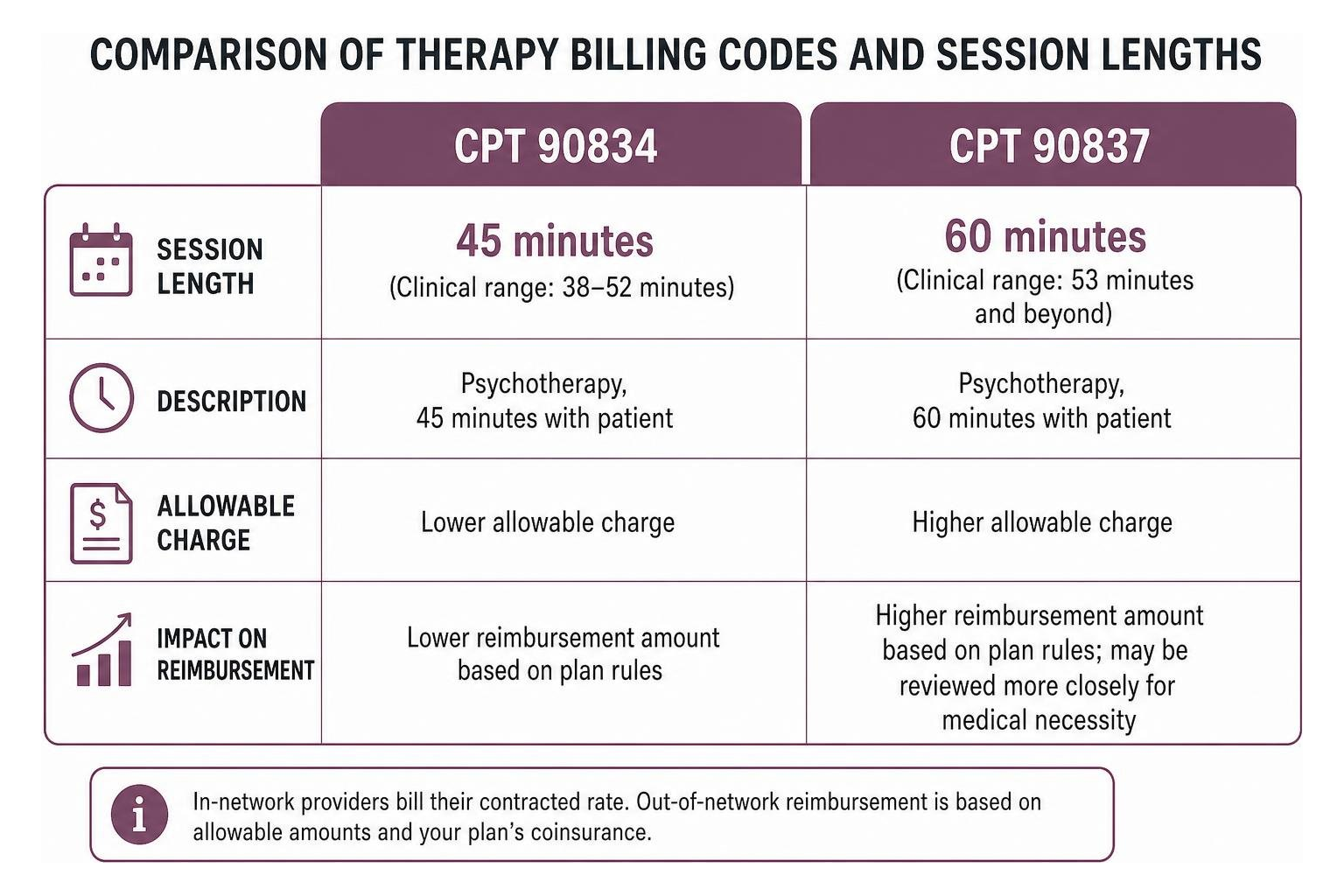
When a therapist submits a claim or provides documentation for your visit, they utilize Current Procedural Terminology codes. The two most common codes for standard individual psychotherapy are:
- CPT 90834: Individual psychotherapy lasting 38–52 minutes.
- CPT 90837: Individual psychotherapy lasting 53 minutes or longer.
The difference between these codes affects reimbursement calculations. While an in-network provider simply bills their contracted rate, an out-of-network arrangement relies on allowable amounts. Insurance reimbursement varies based on the CPT code, the provider’s contracted rates, and the patient’s specific benefits. Longer sessions may have different allowed amounts, and some insurers may review medical necessity or documentation requirements.
Mastering Superbills and Out of Network Claims
Some out-of-network therapists submit insurance claims on behalf of patients, while others require patients to pay directly and submit a superbill to request potential reimbursement. Instead, you pay the practitioner their self-pay rate and receive a specialized itemized receipt called a superbill. Understanding why therapists opt out of insurance networks provides helpful context on why some practices use this model.
A complete superbill must include the following details to prevent claim rejections:
- Provider full name, practice address, and contact details
- National Provider Identifier number
- Provider taxonomy code and state license number
- Patient full legal name, date of birth, and address
- Specific International Classification of Diseases diagnostic codes (ICD 10)
- Exact Current Procedural Terminology billing codes
- Date of service, place of service code, and total amount paid
Missing or incomplete information may delay reimbursement or require additional documentation. Contact your insurance company to confirm its specific submission requirements.
How to Secure a Single Case Agreement When Networks Fall Short
Federal and state regulations establish certain standards for access to behavioral health services, although specific network adequacy requirements vary by insurance plan. If you cannot locate an available in-network therapist, contact your insurer to discuss potential alternatives. If your plan cannot provide an accessible, qualified in-network provider within a reasonable geographic distance or timeframe, you may request a single case agreement, sometimes called a network gap exception.
A single case agreement is a binding contract between your insurance payer and a specific out-of-network clinician. A single case agreement may allow an out-of-network therapist to provide services under specially negotiated reimbursement terms. Depending on the agreement, patients may qualify for in-network cost-sharing, but they should confirm their financial responsibility with their insurer before beginning treatment.

Documenting Network Inadequacy for Plan Approval
Securing a network gap exception requires clear, documented evidence that the existing network cannot meet your clinical needs. If you require targeted care, such as structured care for anxiety, and no local contracted provider has openings, you have strong grounds for an exception.
To build a strong case for your request, document the following:
- Maintain a detailed call log of in network therapists listed in your member directory.
- Record the outcome for each, noting if they have full caseloads, maintain extended waitlists, or fail to respond.
- Highlight any specialized clinical interventions required for your condition that available network clinicians do not provide.
- Contact member services, present your log demonstrating network inadequacy, and request a formal network gap exception.
- If the initial customer service representative hesitates, politely ask to escalate the request to a care manager or clinical supervisor.
Private Practice vs. Online Platforms: Evaluating Total Cost and Care
When exploring care, you will likely encounter independent private practices, group collectives, and subscription based digital therapy platforms. Each model handles billing, appointment length, and clinician relationships differently.
Independent private practices and group collectives typically offer standard forty five or sixty minute sessions with consistent clinicians. Many contract directly with health plans, meaning they handle all claims administration and charge only your assigned copayment.
Digital subscription platforms often charge weekly or monthly subscription fees. While some now accept health coverage, session durations may be limited to thirty or forty five minutes, and coverage can vary widely depending on employer carve outs. Evaluating total visit lengths, out of pocket costs, and clinician continuity helps determine the best fit for your healing journey. For a broader look at how these models compare, the American Psychological Association offers guidance on selecting a therapist and understanding different care settings.
Frequently Asked Questions About Finding an In Network Therapist
How often should I verify my therapist’s in network status?
It is best practice to verify your therapist’s network status at least once every plan year, typically during annual open enrollment or at the start of the calendar year. Insurance contracts between private practices and payers can shift, and provider panels occasionally change. Additionally, your own plan deductible resets annually, which can alter your out of pocket costs for your initial visits of the calendar year.
Why do HMO plans require a primary care referral for mental health therapy?
Health Maintenance Organization plans operate on a managed care structure where a primary care physician coordinates all specialized medical and behavioral care. The primary care doctor assesses initial symptoms and issues a formal electronic authorization to an in-network specialist. Some HMO plans require referrals or prior authorization for certain behavioral health services, while others allow members to schedule outpatient mental health appointments directly. Check your plan’s requirements before scheduling to avoid unexpected costs or coverage issues.
What should I do if a therapist’s bill exceeds the Good Faith Estimate?
If you are uninsured or paying without insurance and receive a bill that is at least $400 higher than your Good Faith Estimate, you may qualify for the federal patient-provider dispute resolution process. You generally have 120 calendar days from the date of the initial bill to begin the dispute. You can also contact the provider directly to discuss the charges. Contact the practice within a reasonable window of the invoice date to discuss the discrepancy. If the provider does not adjust the bill, you can submit a formal dispute through the federal dispute resolution system managed by healthcare regulatory authorities.
Conclusion
Finding affordable, high quality counseling should not be complicated by billing uncertainty. By taking a payer first approach, confirming network contracts directly with billing coordinators, and using your rights under federal billing laws, you can protect your financial well being while prioritizing your mental health.
Taking a few moments to confirm billing details upfront ensures you can focus entirely on personal growth and clinical progress. If you are ready to begin therapy with transparent insurance integration, you can easily connect with a licensed counselor who accepts your plan and understands your unique goals.